
If you’re building or maintaining a deck in Indianapolis, you’re dealing with one of the most punishing climate profiles in the Midwest. Indianapolis deck lifespan factors like freeze–thaw swings, high moisture load, temperature volatility, UV intensity, and aggressive pest activity combine into a perfect storm that shortens the lifespan of average decks by years. Decks here simply do not age the way they do in the South, Pacific Northwest, or Mountain West.
This guide breaks down exactly why decks in Indianapolis fail faster, what materials truly last, and what homeowners and contractors can do to extend deck life despite a climate that’s constantly working against them. Prepare for blunt truth, local examples, and specific recommendations that can save you thousands over your deck’s lifespan.
The Real Lifespan of Decks in Indianapolis
The typical national guidance says:
- Pressure-treated wood deck lifespan: 10–15 years
- Cedar deck lifespan: 15–20 years
- Composite deck lifespan: 25–30 years
- PVC deck lifespan: 30+ years
- Trex deck lifespan: 25–35 years (depending on generation)
Those numbers hold up in many parts of the country — but not in Indianapolis. The climate here is harsher on decks than the national average, and almost every material sees reduced lifespan once exposed to Indianapolis’s conditions.
In Indianapolis, those numbers drop almost across the board because of:
- Repeated freeze–thaw cycles
- Humidity and moisture intrusion
- High UV exposure
- Wide temperature swings
- Heavy precipitation
- Soil movement
- Carpenter bees, termites, and wood-boring beetles
Indianapolis simply punishes deck materials harder and faster, which is why decks here rarely reach the top end of the national lifespan ranges without exceptional maintenance and high-quality construction.
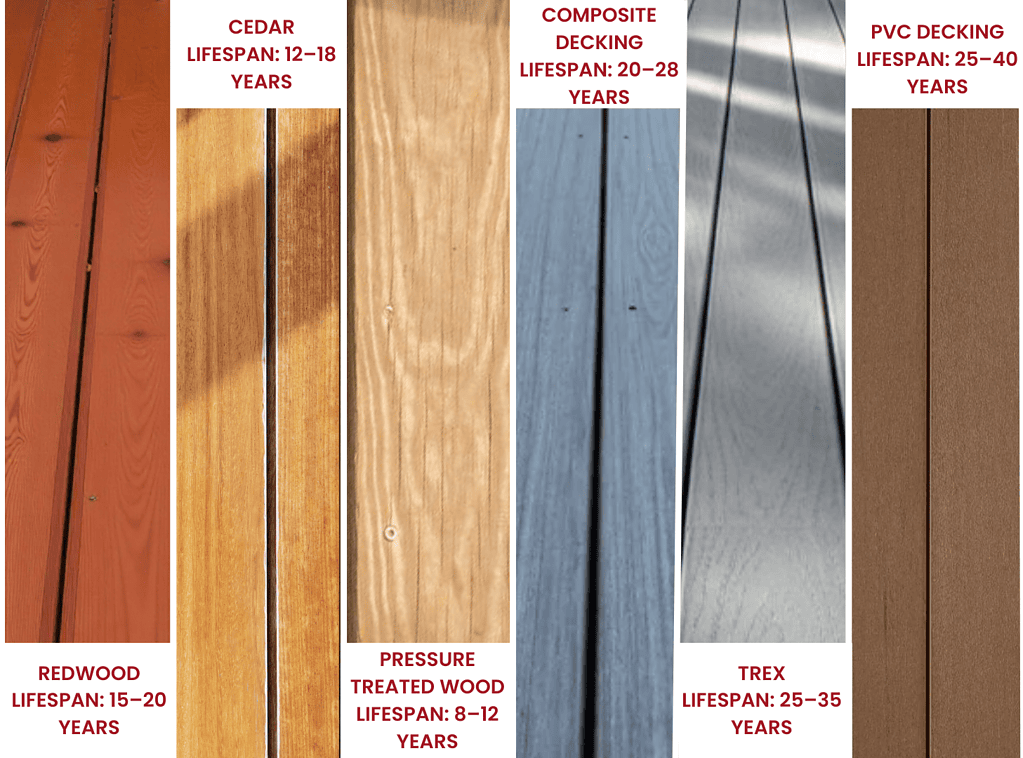
Adjusted Indianapolis deck lifespans (realistic ranges):
| Material | Realistic Indianapolis Lifespan |
| Pressure-treated lumber | 8–12 years |
| Cedar | 12–18 years |
| Redwood | 15–20 years (rare locally, still underperforms vs Western climates) |
| Composite | 20–28 years |
| Trex (capped composite) | 25–35 years |
| PVC | 25–40 years |
Why Indianapolis Decks Age Faster?
Every one of these factors directly impacts the lifespan of a deck in Central Indiana. And ignoring even one of them prematurely ages a structure—fast
1. Freeze–Thaw Cycles: The Silent Deck Killer
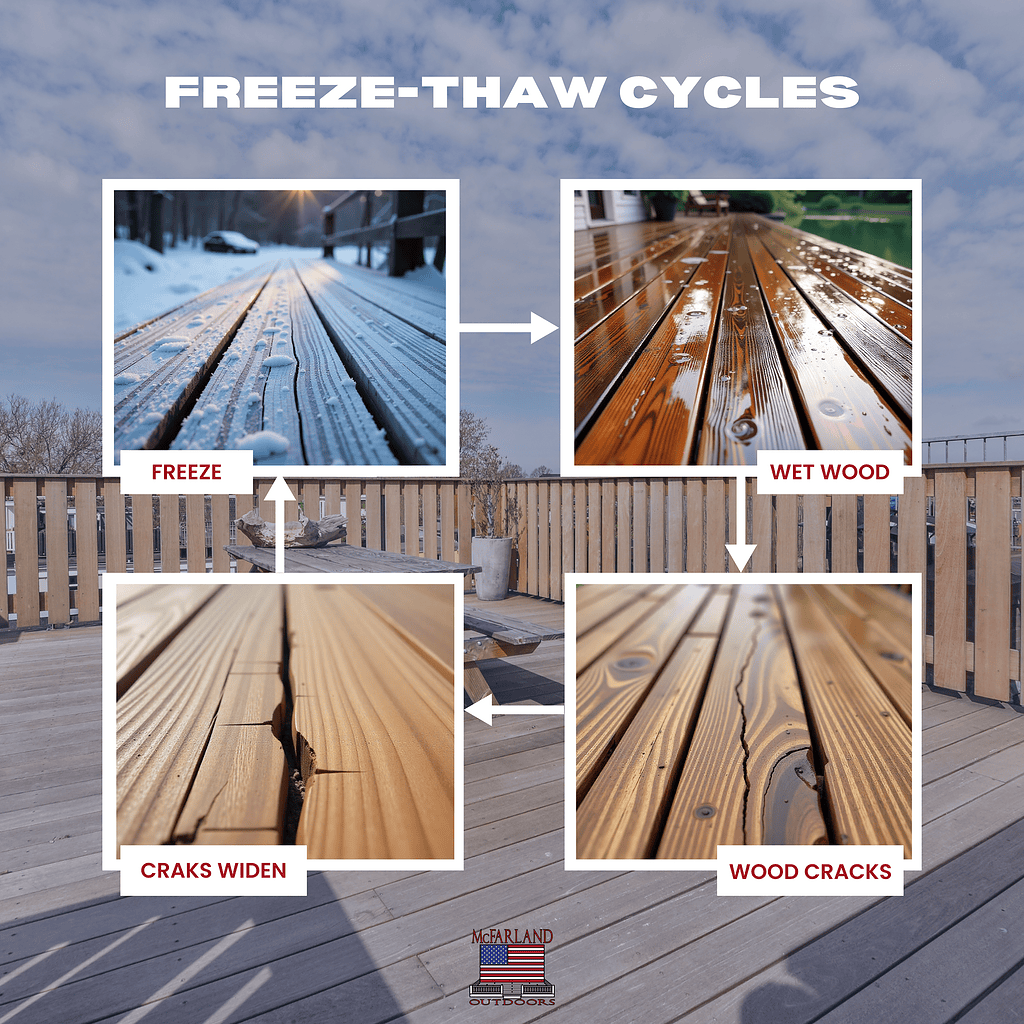
Indianapolis experiences 60–80 freeze–thaw cycles per year on average. That means temperatures bouncing above and below freezing—sometimes on the same day.
This is catastrophic for deck lifespan because:
- Wood repeatedly expands and contracts, causing checking, cracking, and splitting.
- Fasteners loosen as boards move microscopically thousands of times each winter.
- Moisture intrusion freezes in micro-cracks, widening them and accelerating rot.
- Ledger boards experience the most stress—Indianapolis’s #1 failure point.
Example:
A north-facing Meridian-Kessler deck with boards that thaw slowly in shade often experiences early-onset splitting and cupping by year 4–5 compared to a south-facing deck that stays drier.
2. High Humidity & Moisture Intrusion
Indiana summers are among the most humid in the United States, with moisture levels routinely hitting 70–90%. That level of constant humidity forces decks to stay damp far longer than they should, even after light storms. When the wood never fully dries out, the structural components begin breaking down much faster than national averages.
High humidity in Indianapolis accelerates:
- Rot and fungal decay
- Mold and mildew
- Fastener corrosion
- Post and joist deterioration
- Deck-board swelling
Even cedar—often marketed as “rot-resistant”—struggles here because the humidity prevents it from drying between rain cycles. Pressure-treated lumber in Indianapolis usually begins rotting from the underside first, where trapped moisture sits and homeowners rarely inspect. Composite decking isn’t immune either; moisture trapped below composite boards causes joist rot, one of the most common hidden failures in pre-2010 decks across the Indianapolis metro.
3. Indiana UV Exposure: Sun Damage Most People Underestimate
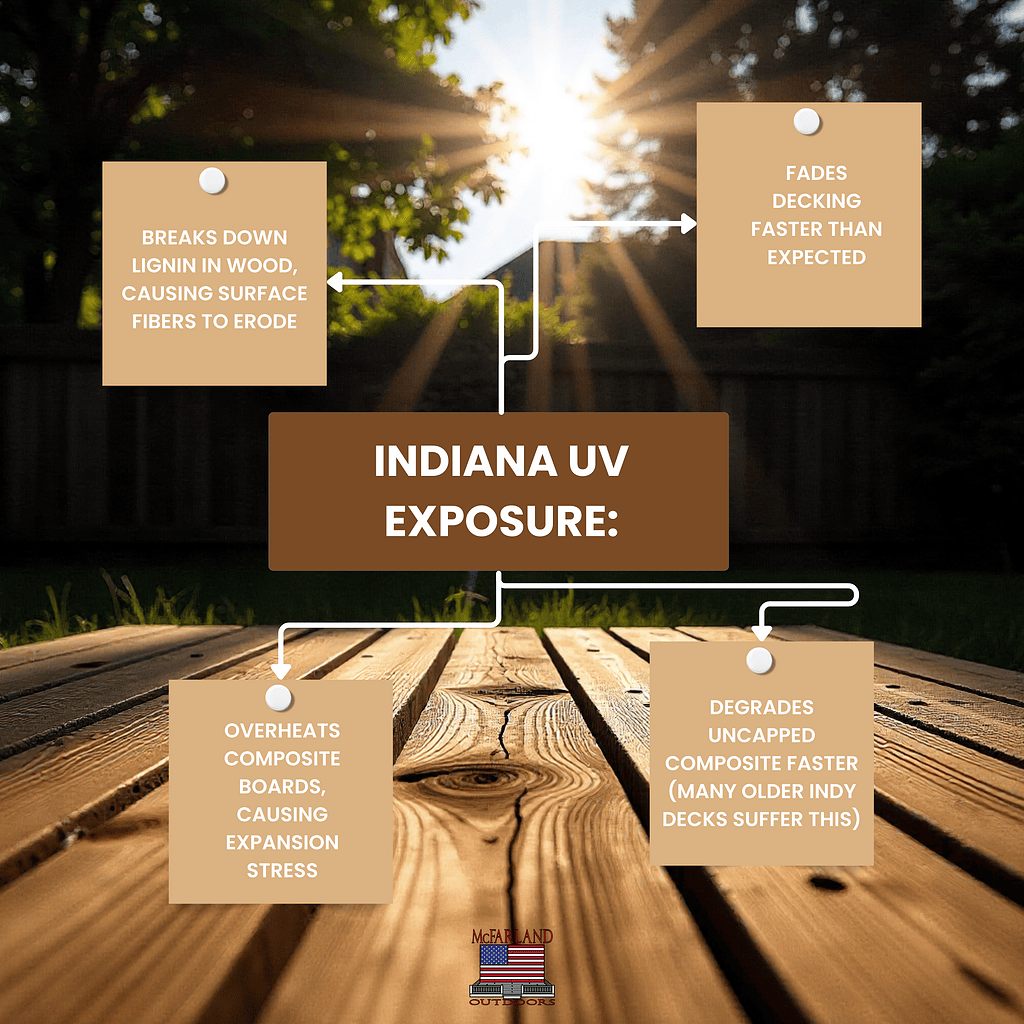
Indianapolis sits far enough south to receive strong, sustained UV exposure, and it hits south-facing decks in areas like Carmel, Greenwood, and Broad Ripple the hardest. The sun here breaks down deck materials faster than most homeowners expect, especially on structures that aren’t shaded or regularly sealed.
What UV does in Indianapolis:
- Breaks down lignin in wood, causing surface fibers to erode
- Fades decking far faster than expected, especially on unshaded boards
- Overheats composite boards, creating expansion stress that loosens fasteners
- Degrades uncapped composite quickly, which is why many older Indianapolis decks show severe wear
Trex and capped composites handle UV considerably better, but PVC remains the top performer in resisting heat, color fade, and surface breakdown.
Example:
A south-facing deck in Broad Ripple with zero shade will lose most of its original stain color within one to two seasons, and the boards will begin to dry out and check unless they’re resealed annually.
4. Annual Precipitation: A Constant Rot Accelerator
Indianapolis receives 42–45 inches of precipitation every year, and it doesn’t fall in calm, predictable patterns. The region cycles through heavy summer storms, periodic flooding, long stretches of damp fall weather, and rapid snowmelt events that saturate the ground repeatedly. This constant moisture load forces decks to stay wet far longer than they should, especially in shaded areas or yards with poor drainage.
Common precipitation patterns in Indianapolis include:
- Heavy summer storms
- Occasional flooding
- Long periods of damp fall weather
- Rapid snowmelt events
All of this contributes to prolonged wetness in key structural components, including:
- Joists
- Ledger boards
- Stairs
- Posts set in poor-draining soil
- Hidden framing cavities
It’s the ongoing, repeated moisture exposure—not isolated storms—that accelerates rot and quietly destroys the structural integrity of Indianapolis decks. This cumulative soaking is why so many decks show joist rot years before the surface boards show any obvious signs of failure.
5. Soil Movement & Ground Moisture
Central Indiana’s clay-heavy soils expand dramatically when wet and shrink hard when dry, creating constant ground movement beneath deck structures. That shifting puts stress on every load-bearing component, and it’s one of the biggest reasons Indianapolis decks go out of alignment earlier than expected. Even well-built decks start to show symptoms when the soil cycles through wet springs, dry summers, and freeze–thaw winters.
This movement causes:
- Post heave
- Stair misalignment
- Ledger stress
- Wobbly railings
- Fastener loosening
Decks built without proper footings set below the frost line (42 inches in Marion County) are the most vulnerable, because shallow posts move with the soil instead of resisting it. Once that happens, the entire structure begins shifting—and the instability only gets worse each season.
6. Local Pest Pressure
Indianapolis homeowners face unusually high pest pressure, and the insects that thrive here target deck framing more aggressively than most people realize. The combination of humid summers, wooded neighborhoods, and older housing stock creates ideal conditions for wood-boring pests. Once they get into the framing, they compromise structural integrity faster than weather alone ever could.
Indianapolis homeowners commonly deal with:
- Carpenter bees – drill perfect half-inch holes in cedar and pressure-treated lumber
- Termites – especially active around older homes in Butler-Tarkington, Fountain Square, and Irvington
- Powderpost beetles – infest untreated or poorly sealed lumber
- Ants – colonize damp joists and accelerate rot in moisture-prone areas
Composite and PVC boards eliminate pest damage only on the surface, but they do nothing to protect the underlying wood framing. If pests reach the joists, beams, or posts, the deck will deteriorate regardless of the material used for the surface.
7. Temperature Swings & Seasonal Extremes
Indianapolis experiences roughly 110°F of annual temperature swings, shifting from sub-zero winters to 90°F+ summers. Those extremes force every deck material to expand, contract, and shift far more than builders in milder climates ever have to account for. Over time, this cycling doesn’t just stress the decking—it weakens the entire structural system.
These temperature swings create:
- Board expansion/contraction
- Fastener backing
- Gapping in composite
- Accelerated checking in wood
- Railing instability
PVC expands more than any other material, which is why installation gaps are so critical. Capped composite expands moderately but still moves enough to open up seams if installed incorrectly. Wood expands the least, but it cracks more aggressively, especially when winter dryness follows humid summer months.
8. Local Materials & Contractor Standards
Most Indianapolis decks rely on a few common materials. Pressure-treated pine is the most widely used but has the shortest lifespan. Cedar looks great but reacts poorly to Indianapolis’s humidity. Trex composite is gaining ground for low maintenance, while PVC (Azek) delivers the longest service life.
Most decks in Indianapolis are built with:
- Pressure-treated pine
- Cedar
- Trex composite
- PVC (Azek)
The bigger issue is workmanship. Contractor quality varies hugely across the Indianapolis area, and small construction mistakes end up causing most premature failures—not the surface material itself.
The biggest lifespan mistakes we see:
- Ledger not flashed properly
- Incorrect fastener selection
- Joists spaced too wide for composite
- Posts set too shallow
- No ground moisture mitigation
- Railing posts not blocked properly
A deck is only as strong as its substructure, and Indianapolis’s climate exposes weak work fast.
9. Typical Indianapolis Homeowner Maintenance Habits
This is where many Indianapolis decks fail prematurely. Homeowners often don’t realize how quickly Indianapolis’s humidity, soil, and weather punish a deck that isn’t maintained consistently.
Common Indianapolis homeowner patterns:
- Staining wood decks every 3–5 years instead of every 1–2
- Power-washing too aggressively
- Letting leaves accumulate in shade
- Ignoring mildew until it’s widespread
- Not clearing snow (freeze–thaw stress multiplies)
- Not replacing corroded fasteners
- Letting soil build up against posts
Most decks in Indianapolis are under-maintained, and the climate amplifies the consequences far faster than homeowners expect.
Deck Material Breakdown: How Each Performs in Indianapolis
Below is the reality check on how every major deck material holds up once exposed to Indianapolis conditions-not the marketing claims.
Pressure-Treated Wood
- Real Indianapolis lifespan: 8–12 years
- Weaknesses: humidity, rot, freeze–thaw, pests
- Strengths: affordable, easy to repair, widely available
PT decks fail fastest here—usually from rot in joists and beams, not from the boards themselves.
Cedar
- Real Indianapolis lifespan: 12–18 years
- Weakness: high humidity, carpenter bees
- Strength: natural rot resistance, better aesthetics
Cedar performs far worse here than in the Pacific Northwest because Indiana humidity keeps it from drying out.
Redwood
- Real Indianapolis lifespan: 15–20 years
- Weakness: humidity, fungal pressure, wood-boring insects
- Strength: naturally stable, strong rot resistance compared to pine
Redwood is rare in Indianapolis, and it never performs as well here as it does in the dry Western climates where it’s harvested.
Composite Decking
- Real Indianapolis lifespan: 20–28 years
- Weakness: expansion, older uncapped composite prone to mold
- Strength: low maintenance, resistant to rot and pests
Composite performs well but only if framing is built above code.
Trex (Capped Composite)
- Real Indianapolis lifespan: 25–35 years
- Weakness: early uncapped generations aged poorly, but modern Trex fixed most of those issues
- Strength: excellent UV resistance, strong moisture protection, low upkeep
Modern Trex decks performs far better in Indianapolis than its older versions thanks to the high-performance outer shell. It resists fading, moisture intrusion, and surface breakdown, making it one of the most reliable long-term choices for this climate.
PVC Decking (Azek, etc.)
- Real Indy lifespan: 25–40 years
- Weakness: significant thermal expansion, requires proper gapping
- Strength: unmatched moisture, rot, and insect resistance
PVC excels in Indianapolis because it doesn’t absorb water, doesn’t host pests, and tolerates freeze–thaw cycles better than any wood-based material. When installed correctly, it delivers the longest service life and the most stable performance in Indy’s humidity and temperature extremes.
Material Comparison Table (Indianapolis-Specific)
| Material | Lifespan (Indy) | Rot Resistance | UV Resistance | Pest Resistance | Maintenance Level |
| PT Wood | 8–12 yrs | Low | Low | Low | High |
| Cedar | 12–18 yrs | Medium | Medium | Low (carpenter bees) | Medium |
| Redwood | 15–20 yrs | Medium | Medium | Medium | Medium |
| Composite | 20–28 yrs | High | Medium | High | Low |
| Trex Capped Composite | 25–35 yrs | High | High | High | Low |
| PVC | 25–40 yrs | Very High | Very High | High | Very Low |
Maintenance Expectations for Indianapolis Homeowners
If you want to reach the upper end of lifespan, here’s the truth:
Wood decks (PT or cedar)
- Clean annually
- Seal/stain every 1–2 years
- Clear snow quickly
- Keep debris off
- Inspect framing and fasteners yearly
Composite & Trex decking
- Clean 1–2 times per year
- Ensure proper ventilation under deck
- Check framing every 2–3 years
PVC
- Simple wash annually
- Monitor expansion/gapping
- Keep gutters from dumping water onto deck
Tips to Extend Deck Life in Indianapolis’ Climate
1. Upgrade framing to ground-contact grade lumber
Standard lumber can’t handle Indy’s moisture. Ground-contact lumber tolerates constant wet soil and resists fungus far better, reducing early joist rot.
2. Use hidden fasteners or stainless screws
Hidden fasteners eliminate surface penetrations that pull in water. Stainless screws prevent rust and keep the structure tight for years.
3. Install proper ledger flashing + waterproof membrane
The ledger is Indy’s #1 failure point. Good flashing blocks water at the house connection, and a membrane adds backup protection.
4. Improve drainage around posts and stair bases
Clay soil holds water. Better drainage keeps posts from soaking and reduces frost heave and stair shifting.
5. Shade south-facing decks
Shade cuts UV exposure dramatically. It prevents heat-related warping, fading, and expansion stress.
6. Ventilate the underside of composite and PVC decks
Airflow stops humidity from getting trapped. Ventilation reduces mold and limits expansion and contraction issues.
7. Seal cut ends of wood boards
End grain absorbs water fastest. Sealing it blocks moisture, prevents rot, and extends board life.
8. Clear snow, don’t let it melt naturally
Snow adds major moisture load. Removing it stops checking, loosening fasteners, and freeze–thaw damage under the deck.
Conclusion
Indianapolis decks don’t live long by accident. They last because homeowners and contractors understand the Indianapolis deck lifespan factors working against them—moisture, UV, pests, soil movement, and relentless freeze–thaw cycles. Ignoring these pressures is exactly why so many decks in the city fail years earlier than expected.
Choose better materials. Build above code. Maintain proactively. And base decisions on Indiana realities—not national averages or generic advice.
If this guide helped you, share it with other Indy homeowners or contractors. With the cost of rebuilding today, helping someone avoid preventable failure can save them thousands.
Serving: Indianapolis • Carmel • Westfield • Noblesville • Greenwood • Bargersville • Zionsville

Proven business leader with a strong track record of founding, growing, and scaling successful small businesses. Experienced in building companies from the ground up, driving sustainable growth, and leading teams through all stages of development. In the past year, led the delivery of 45+ custom deck projects. Skilled in identifying new business opportunities, developing and mentoring talent, and managing the full scope of daily operations—from sales and pricing strategy to financial oversight and execution. Known for operational excellence, strong financial acumen, and a continuous-improvement mindset that drives performance across every area of the business.