
Choosing the right deck size isn’t as simple as picking a rectangle and hoping it feels right. A deck can transform the way you live – extending your home, elevating your property value, and creating a space where people naturally gather. But the wrong deck size? It feels cramped, awkward, or disconnected from your home’s architecture.
Most homeowners only build one major outdoor living structure in their lifetime.
Your first decision, the size, is the one that determines everything else.
This guide walks you through how to choose the right deck size for your home in Indiana using real design principles, functional planning frameworks, Indiana-specific building considerations, and insights from McFarland Outdoors’ experience building premium outdoor spaces.
What “Average Deck Size” Really Means (and Why It Misleads Central Indiana Homeowners)
Most national articles claim the average deck size is 300–400 sq. ft.
And while that range shows up everywhere, here’s the truth:
The average is meaningless in Central Indiana.
Why? Because Indiana neighborhoods, lot configurations, and architectural styles are wildly different from the markets those “average deck sizes” were based on.
Competitor consensus: 300–400 sq. ft.
TimberTech, Woodland, and Skyview all push the same generic benchmark.
But in Indiana?
300–400 sq. ft. may be perfect… or absolutely wrong.
Let’s break down why.
Why That Range Is Meaningless Without Context
Two homes can be the same square footage and require completely different deck sizes if:
- Their yard depth differs by even 10 feet
- Their rear façade has different window/door placement
- Their HOA limits covered structures or impervious surfaces
- Their lot slopes toward or away from the home
- Their outdoor living goals aren’t the same
Averages don’t build great decks – context does.
How Indiana-Specific Factors Shift the “Average”
1. Narrow lots in Fishers / Noblesville subdivisions
Many Hamilton County neighborhoods have:
- Tight setbacks
- Shallow rear yards
- HOA height restrictions
- Limited privacy buffer
A 12×16 or 14×20 deck may be the functional maximum even if the home is large.
Going bigger often destroys usability of the remaining yard.
2. Walkout basements in Geist-area homes
Walkouts increase deck height, which increases:
- Structural load requirements
- Number of footings
- Cost per square foot
These homes often justify larger upper decks, because the usable backyard exists at the lower level.
A 400–600 sq. ft. upper deck is common around Geist because homeowners want:
- Covered lounge zones
- Dining areas
- Stairs connecting to a patio living space
3. HOA coverage limits in Carmel / Zionsville
Some HOAs restrict:
- Total impervious surface percentage
- Deck coverage footprint
- Location of shade structures
- Rail and stair orientation
A homeowner may want a 450 sq. ft. deck but only be allowed 280 sq. ft.
This changes layout, zones, and cost.
Why Deck Size Matters More Than Homeowners Think
A well-designed deck is more than a platform. It should:
- Support your lifestyle (dining, grilling, lounging, entertaining, etc.)
- Align with Indiana property lines, frost-depth requirements, and code setbacks
- Complement your home’s architectural proportions
- Transition cleanly into landscaping, patios, and outdoor kitchens
- Maintain long-term value and curb appeal
- Withstand four-season Indiana weather
Most decks fail not because they’re poorly built — but because they’re poorly sized.
Average Deck Sizes in Indiana (And Why They’re Only a Starting Point)
Across the Midwest, the average attached deck falls between 300–400 sq. ft. But averages don’t design great outdoor spaces — purpose does.
Common Deck Sizes Homeowners Consider
- Small Deck: 8×10 to 12×16 (80–192 sq. ft.)
- Medium Deck: 12×16 to 16×20 (190–320 sq. ft.)
- Large Deck: 20×20 to 20×24+ (400–500+ sq. ft.)
These numbers mean nothing until you picture actual furniture, movement flow, and the activities you want the deck to support.
The #1 Rule for Choosing Deck Size in Indiana: Proportion Over Square Footage
A deck should look like a natural extension of your home — not an afterthought.
Most design pros follow this guideline:
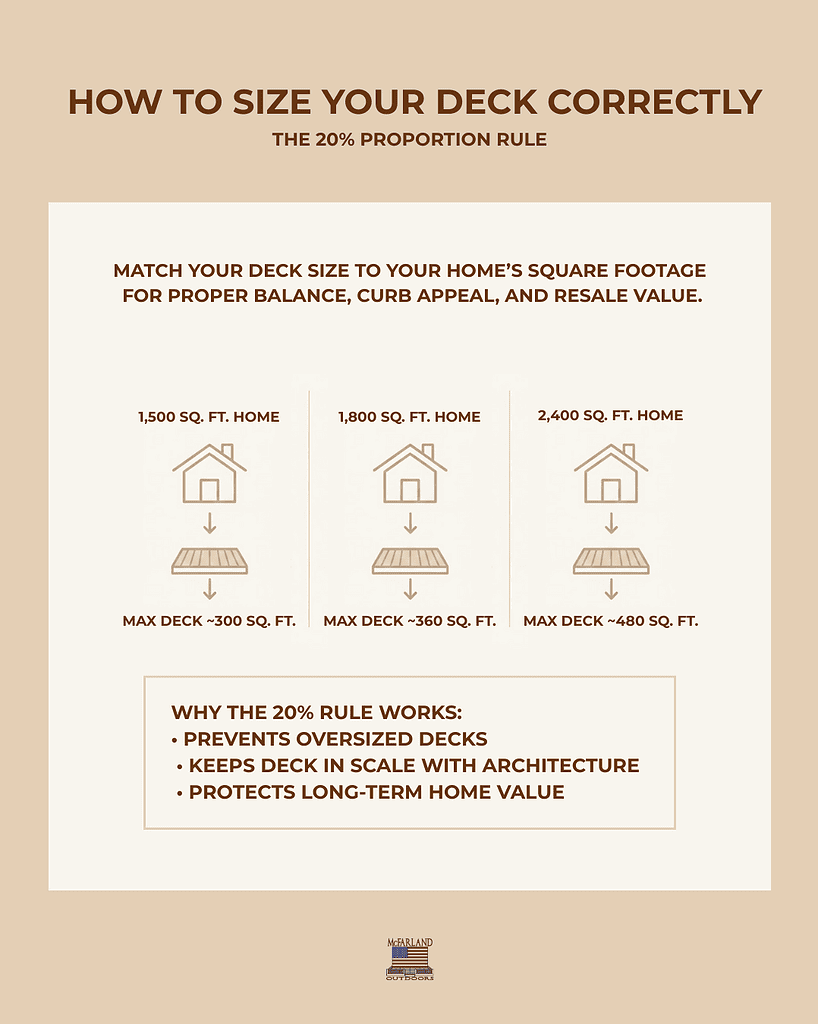
Keep your deck size under 20% of your home’s total square footage.
It’s not a law — but it’s a smart benchmark for balance and curb appeal.
Example:
- 1,800 sq. ft. home → max deck ~360 sq. ft.
- 2,400 sq. ft. home → max deck ~480 sq. ft.
This rule protects homeowners from creating:
- a deck that overwhelms a small home
- a deck too small for a larger façade
- a deck that hurts resale value
Indiana-Specific Considerations That Affect Deck Size
National articles ignore this, but Indiana is not Arizona. You need a deck that functions in a climate with:
- freeze–thaw cycles
- humidity
- high winds in open lots
- tree cover and shade patterns
- drainage challenges
- clay or sandy soils depending on region
1. Frost Line Depth
Indiana frost depth averages 30–36 inches, which affects post sizing and placement. Larger decks mean more footing requirements — which affects cost and engineering.
2. Setback Rules
Every Indiana county has unique zoning rules (some 10′, others 25′ or more). Deck size is often determined by what you’re legally allowed to build — not what you want.
3. Lot Shape and Grade
Indiana neighborhoods are known for awkward lot geometry, slopes, drainage swales, and easements.
This is where McFarland Outdoors’ advantage kicks in:
You’re not just designing a deck — you’re designing an outdoor environment.
Your landscaping division lets you solve elevation, drainage, and retaining problems that other contractors can’t.
How to Choose the Right Deck Size for Your Home in Indiana (Step-by-Step)
Step 1: Define the Primary Purpose of the Deck
You cannot choose the right size until you choose the right lifestyle use-case.
Ask yourself:
- Do we host large gatherings?
- Do we want outdoor dining for 6–10 people?
- Do we want a lounge zone with a sectional?
- Do we want a grill nook?
- Are we adding a hot tub or fire feature?
- Will the deck eventually connect to a patio, pergola, or outdoor kitchen?
Approximate Space Requirements
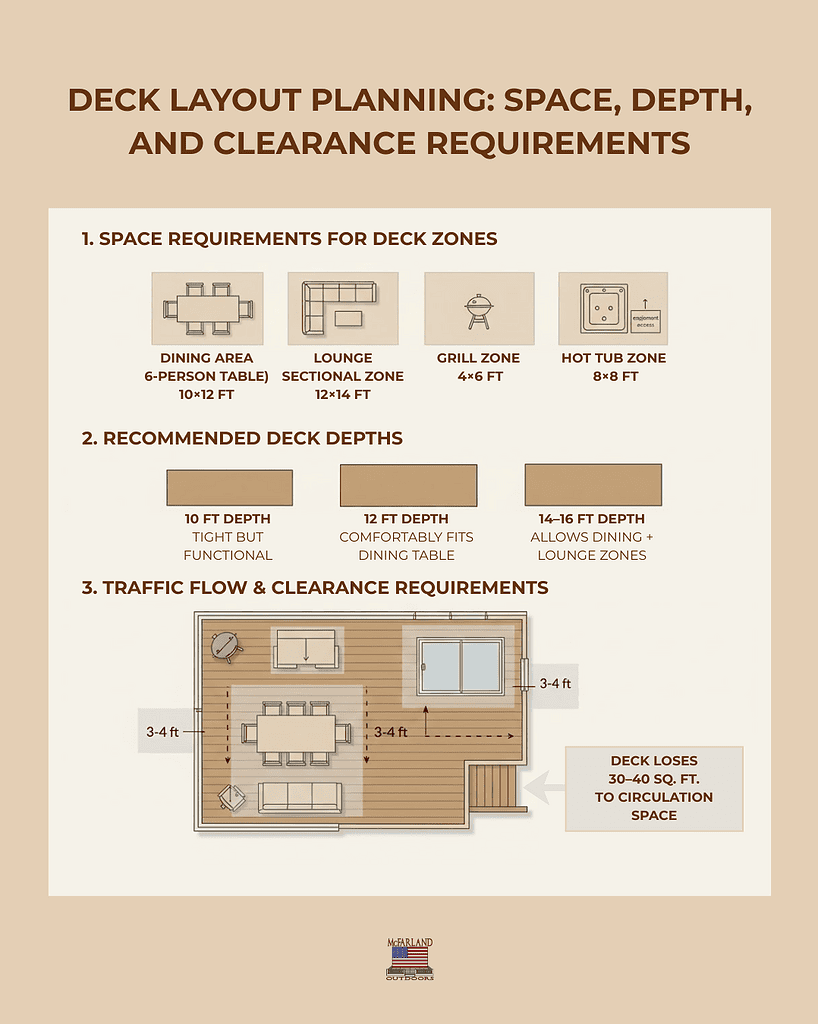
- Dining table for 6 → 10×12 ft minimum
- Sectional lounge zone → 12×14 ft
- Grill zone (safe clearance) → 4×6 ft
- Hot tub → 8×8 ft + equipment access space
This is where most homeowners miscalculate — furniture takes up more space than you think.
Step 2: Choose the Right Deck Depth
Depth is where most decks go wrong.
Industry Minimums:
- 10 ft depth = tight but functional
- 12 ft depth = comfortably fits a dining table
- 14–16 ft depth = allows dining + lounge zones
A deep deck feels more luxurious and functional than a wide but shallow one.
Step 3: Plan for Traffic Flow (The Hidden Space Requirement)
Every deck needs circulation paths with at least 3–4 ft. of clearance around:
- dining tables (chairs pushed out)
- grill areas
- stairs
- sliding doors
- lounge furniture
A 12×16 deck isn’t truly 192 sq. ft. of usable space — you lose 30–40 sq. ft. to movement.
Step 4: Consider Future Expansion (Even If You Don’t Think You Need It)
Indiana homeowners often regret not planning for:
- a future pergola or pavilion
- a hot tub addition
- an outdoor kitchen
- a connecting patio or fire pit area
- a pool or spa down the road
Since McFarland Outdoors now designs hardscapes, outdoor kitchens, and covered structures, your deck should be:
- sized to integrate with future upgrades
- positioned correctly to transition to patios and retaining walls
- engineered to support a pavilion or pergola load
This is where your full-service capability outclasses every competitor.
Step 5: Factor in Budget (Without Letting It Dictate Your Entire Design)
Deck size and cost scale together — but not linearly.
Bigger decks require:
- more beams
- more footings
- larger spans
- more railing
- more stairs
- more labor
But here’s the hidden truth:
It’s cheaper to build the “right” size once than to expand a too-small deck later.
A 20–30% size increase costs far less during original construction than during a renovation.
Step 6: Match the Deck to Your Home’s Architecture
A deck should never look like an appendage.
Good architectural proportioning rules:
- Deck should not exceed the width of the home’s rear façade
- Deck over 20 ft wide should be zoned or broken up visually
- Deck depth should be at least half its width (unless multi-level)
- Covered structures must scale proportionally to the deck size
This is where McFarland Outdoors’ pergolas and covered structures matter — they allow you to design zones that feel intentional, not accidental.
Deck Sizes Compared: What Fits on Small, Medium & Large Decks?
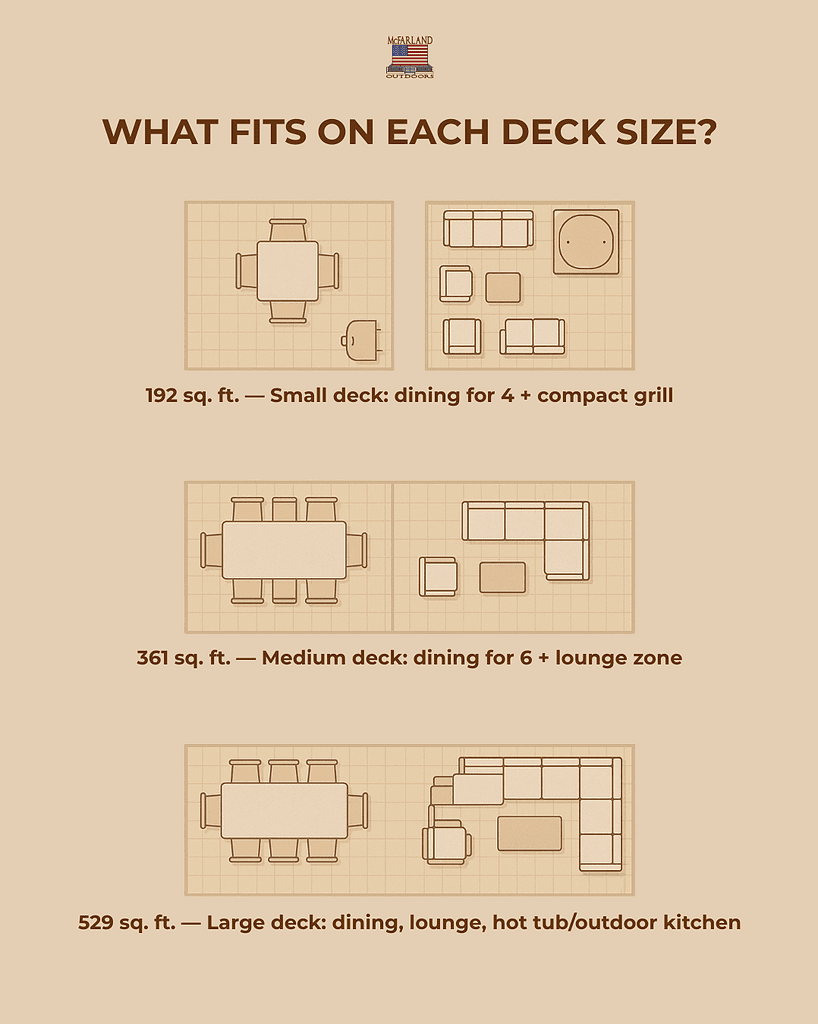
Borrowing from the best visuals in the industry (TimberTech-style), here’s a clearer breakdown:
Small Deck (Up to 200 sq. ft.)
Fits:
- bistro table
- 2–4 chairs
- small grill
Best for:
- compact Indiana lots
- townhomes
- low-maintenance lifestyles
Medium Deck (200–400 sq. ft.)
Fits:
- dining area for 6–8
- grill zone
- small lounge set
Best for:
- families
- Indiana subdivisions
- entertaining small groups
Large Deck (400–600+ sq. ft.)
Fits:
- full dining set
- sectional lounge
- hot tub
- outdoor kitchen
- pergola or pavilion
Best for:
- premium homes
- large rural lots
- lake houses
- homeowners who entertain frequently
Integrating Decks With Hardscapes, Patios & Outdoor Kitchens (Your Competitive Edge)
Here’s where McFarland Outdoors beats everyone you showed me.
Most contractors can build a deck.
Few can design a complete outdoor living environment.
Since you’ve expanded into:
- hardscapes
- retaining walls
- outdoor kitchens
- landscaping design
You should position deck-sizing as phase one in a full outdoor plan — not a standalone decision.
Deck + Patio Combinations (Indiana Favorite)
Many Indiana homeowners choose:
- upper deck for dining
- lower patio for fire pit or lounge
- pergola/pavilion for shade and weather protection
Your expertise allows you to engineer all three holistically.
Common Deck Sizing Mistakes Indiana Homeowners Regret (Avoid These)
From hundreds of builds, here are the top pain points:
- Deck too shallow for dining (10 ft isn’t enough).
- Grill placed too close to seating or doors.
- Stairs interrupting the ideal furniture layout.
- Ignoring sun exposure patterns (Indiana summers are hotter than people expect).
- Underestimating how much space a sectional requires.
- Building a deck without planning for a future covered structure.
Your article is going to outrank the others because you’re telling the truth they avoid for liability reasons.
How to “Test Drive” Your Deck Size Before You Commit
This is the single most effective sizing strategy — and your competitors never mention it.
If you teach homeowners this process, you win trust instantly.
Before signing a contract, homeowners should physically simulate the deck in their yard.
Here’s the exact method McFarland Outdoors recommends:
1. Stake the Perimeter
Use stakes + string or marking paint to outline the deck’s exact footprint.
People immediately see whether the size feels cramped or oversized.
2. Place Real Chairs and Tables Inside the Space
Not theoretical furniture – actual pieces from the home.
This reveals:
- Chair clearance
- Walking paths
- Pinch points
- Hot tub feasibility
- Grill safety zones
3. Walk the Paths
Simulate real activity:
- Carry a tray from “kitchen exit” to “table”
- Walk behind chairs
- Imagine guests moving through zones
If the paths feel tight now, they will feel worse when the deck is built.
4. Add Temporary Shade to Check Sun Exposure
Use:
- umbrellas
- a pop-up canopy
- or even a bedsheet on poles
Indiana sun angles change dramatically season to season.
This test shows where you may later want:
- a pergola
- a pavilion
- or motorized shade
5. Check Privacy Sightlines From Neighbor Windows
Walk into your neighbors’ yard-facing rooms (with permission), stand on a ladder to simulate deck height, and see:
- Do they have a clear view of your seating area?
- Will a future pergola or privacy wall be needed?
- Should the deck shift left/right by a few feet?
Privacy is one of the most overlooked deck-sizing factors.
6. Visualize Snow Management Zones
Indiana winters require dumping snow somewhere.
Make sure your simulated deck:
- includes at least one snow-dump corner
- does not force snow against siding
- keeps heavy piles off access points
No one else teaches homeowners to test-drive their deck size.
This section alone sets your guide apart from every competitor in Indiana.
When You Should Increase the Size (and When You Shouldn’t)
Homeowners often jump straight to “bigger must be better.”
Wrong.
Size is only “right” if it supports usability without sacrificing proportion, yard space, drainage, or budget.
Here’s the expert-level guidance Indiana homeowners actually need.
Increase the Deck Size If…
1. You Entertain Often
If your home is the gathering place for:
- birthday parties
- cookouts
- family holidays
- neighborhood hangouts
…you need separate zones, not a single cramped platform.
2. You Need Multiple Activity Zones
Dining + grilling + lounge + hot tub require more than a medium-size deck.
You need at least 14×20 and sometimes multi-level design.
3. You Have a Walkout Basement
Upper decks over walkouts often justify larger footprints because:
- the lower yard remains fully usable
- an integrated patio can double the total living area
4. Your Home’s Architecture Supports It
Wide façades, tall rear elevations, and symmetrical architecture all support larger decks without looking oversized.
This is especially common in:
- Carmel estates
- Zionsville custom builds
- Geist lake homes
Do NOT Increase the Deck Size If…
1. Your Lot Is Narrow
In many Fishers/Noblesville subdivisions, extra deck width destroys side-yard usability and may violate setbacks.
2. Your Yard Becomes Unusable
If a deck eats your entire lawn, you’ve created a platform — not an outdoor living space.
Balance is key.
3. You’re Compensating for Poor Layout Instead of Fixing Design
If your deck feels too small, it might not be a size problem – it may be:
- furniture placement
- stairs in the wrong location
- doors positioned poorly
- insufficient depth, not width
A smart layout outperforms a bloated deck every time.
4. You Haven’t Budgeted for Shade
In Indiana, full-sun decks are unusable 30–40% of summer afternoons.
If you increase deck size without planning for:
- a pergola
- a pavilion
- or built-in shade
…you’ll end up avoiding the very space you paid for.
Conclusion
A well-sized deck isn’t an expense — it’s an investment in comfort, beauty, and long-term home value. When planned correctly, your deck becomes the anchor for everything else: outdoor kitchens, patios, pergolas, gardens, and multi-season entertainment.
If you want a deck that fits your home, lifestyle, and future plans, the next step is simple:
Request a design consultation with McFarland Outdoors — Indiana’s experts in complete outdoor living environments.

Proven business leader with a strong track record of founding, growing, and scaling successful small businesses. Experienced in building companies from the ground up, driving sustainable growth, and leading teams through all stages of development. In the past year, led the delivery of 45+ custom deck projects. Skilled in identifying new business opportunities, developing and mentoring talent, and managing the full scope of daily operations—from sales and pricing strategy to financial oversight and execution. Known for operational excellence, strong financial acumen, and a continuous-improvement mindset that drives performance across every area of the business.