
Most homeowners assume decks wear out because of age. That’s wrong. Decks fail early because moisture, movement, and neglected connections compound over time—usually out of sight. By the time problems are obvious, repairs are no longer optional.
This deck maintenance checklist is designed to do one thing competitors rarely address: stop small issues from becoming structural failures. It’s not about cosmetic upkeep. It’s about preserving load paths, drainage, and material integrity—whether you have a wood deck or a modern composite system.
Why a Real Deck Maintenance Checklist Matters
Why most decks fail earlier than expected
According to safety data compiled by the North American Deck and Railing Association, the majority of serious deck failures originate at connection points—ledger boards, fasteners, and stairs—not from surface wear. These failures are rarely sudden; they’re progressive.
Cosmetic maintenance vs. structural maintenance
Cosmetic maintenance keeps a deck looking acceptable.
Structural maintenance keeps it standing.
Cleaning alone does not prevent:
- Ledger board moisture intrusion
- Fastener corrosion and withdrawal
- Framing rot at posts and stair stringers
A proper checklist addresses both.
What maintenance can prevent — and what it can’t
Maintenance can:
- Slow moisture absorption
- Reduce material fatigue
- Extend usable lifespan
Maintenance cannot:
- Fix undersized framing
- Correct improper ledger attachment
- Reverse advanced rot
This checklist is for homeowners, not full rebuild DIYers. It helps you identify issues early and know when to escalate.
How to Use This Deck Maintenance Checklist
What to inspect yourself vs. when to call a professional
You can safely handle visual inspections, cleaning, and minor fastener tightening. Structural movement, ledger concerns, or widespread rot are professional territory.
How deck age and exposure change priorities
A 5-year-old deck in full sun fails differently than a 20-year-old shaded deck. Drainage, airflow, and fastener condition matter more with age than surface appearance.
Why skipping steps creates hidden damage
Deck damage compounds silently. Skipped inspections don’t cause immediate failure—they allow moisture and movement to accelerate it.
Core Deck Maintenance Checklist (Applies to All Decks)
Inspect the Deck Structure and Surface
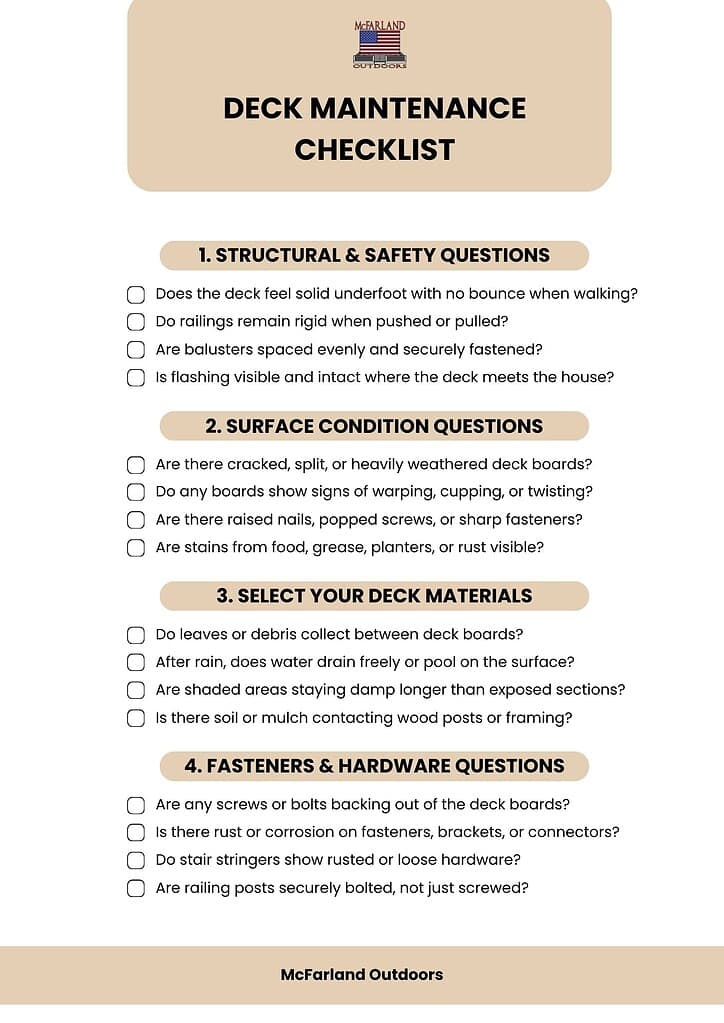
- Deck boards: cracks, splitting, cupping, soft spots
- Railings and stairs: movement, looseness, sway
- Ledger board: separation, flashing damage, corrosion
- Support posts and visible framing: rot, soil contact, insect activity
Why it matters: Early detection prevents partial repairs from becoming full rebuilds.
Check and Secure Fasteners
- Backing-out screws or nails
- Rusted or corroded fasteners
- Stair stringer and railing connections
What happens if skipped: Movement accelerates fastener fatigue, widens gaps, and traps moisture—shortening deck life dramatically.
Clean the Deck Surface Properly
- Remove debris between boards (leaves trap moisture)
- Use material-appropriate cleaners only
- Avoid aggressive pressure washing
Important boundary: Cleaning is maintenance. Stripping wood fibers or scarring composite caps is damaging.
Identify Repairs That Shouldn’t Be Delayed
- Loose or flexing boards
- Cracks spreading along the grain
- Early rot at posts or stairs
Clear line: Maintenance ends where structural repair begins.
Wood Deck Maintenance Checklist
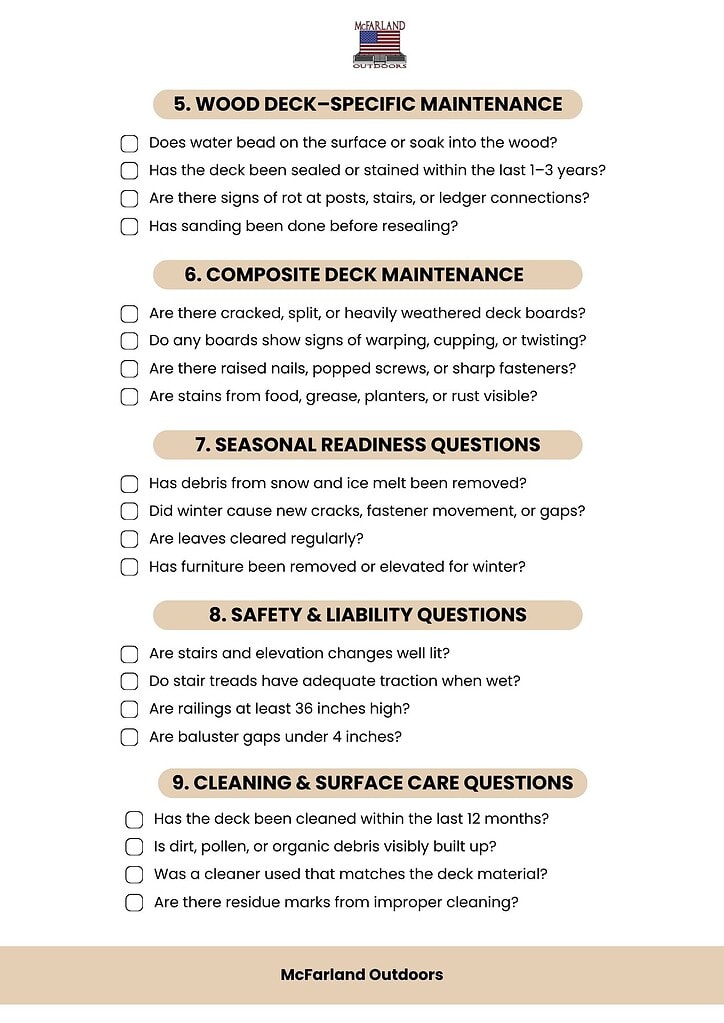
Inspect for Moisture Damage and Rot
High-risk zones include:
- Stair stringers
- Post bases near soil
- Shaded framing
- Ledger boards
Surface wear looks dry and splintered. Structural decay feels soft and spongy when probed.
Sanding and Sealing: When and Why It’s Necessary
Wood absorbs moisture. Sealers and stains slow that process.
- Sealing reduces swelling and checking
- UV protection limits surface breakdown
- Water repellency delays rot
Signs it’s time to reseal: Water no longer beads on the surface. Color fades unevenly. Grain raises after rain. This is performance-based—not calendar-based.
Wood-Specific Maintenance Mistakes to Avoid
- Trapping moisture under rugs or planters
- Sealing without cleaning or sanding
- Assuming pressure-treated lumber is maintenance-free
Composite Deck Maintenance Checklist
What Composite Decks Still Need (and Don’t)
Composite resists rot and insects—but not:
- Surface mold film
- Fastener movement
- Expansion-related stress
Inspections still matter.
Cleaning Composite Without Damaging It
- Use pH-neutral, composite-approved cleaners
- Avoid bleach and solvents
- Clean mold film before it embeds in texture
Harsh chemicals can void warranties and permanently discolor caps.
Common Composite Maintenance Myths
- “Composite doesn’t need maintenance” — false
- “Mold means failure” — false
- “All composite is the same” — false
Manufacturers simplify. Reality doesn’t.
Deck Maintenance Tips That Actually Prevent Failure
- Keep drainage paths clear
- Avoid moisture-trapping accessories
- Monitor high-traffic zones
- Observe water flow after rain
Why this works: Observational maintenance catches problems checklists miss.
DIY Deck Maintenance vs. When to Call a Professional
Maintenance Tasks Homeowners Can Safely Handle
- Cleaning
- Visual inspections
- Tightening accessible fasteners
When Maintenance Is No Longer Enough
- Sagging or bounce in framing
- Repeated board failures
- Ledger board concerns
- Widespread rot
This is where responsible homeowners stop guessing.
Deck Maintenance in Central Indiana
Why Climate and Moisture Matter Here
In areas like Indianapolis, freeze–thaw cycles and seasonal humidity accelerate fastener fatigue and moisture intrusion. Decks age faster when maintenance is skipped—even briefly.
What Homeowners Should Watch Closely
- Drainage and runoff patterns
- Shaded decks with poor airflow
- Older framing standards that predate modern codes
A Note on Winter Deck Maintenance
Winter introduces unique risks—ice expansion, trapped moisture, and fastener stress.
For cold-weather specifics, see our Winter Deck Maintenance Tips guide.
Final Checklist Summary — How to Extend Your Deck’s Life
Check annually
- Ledger board
- Fasteners
- Stairs and railings
- Framing and posts
Monitor continuously
- Water behavior after rain
- High-traffic wear zones
- Surface drainage
Never ignore
- Movement
- Soft wood
- Corrosion
Download the Deck Maintenance Checklist (Free)
Deck problems don’t usually announce themselves — they compound quietly. This downloadable Deck Maintenance Checklist turns everything in this guide into a clear, step-by-step inspection you can use year after year. Walk your deck, answer the questions, and quickly see what’s routine maintenance, what needs attention, and what shouldn’t be ignored. It’s designed for homeowners who want to protect their deck’s safety, lifespan, and value — not guess their way through it.
Conclusion
Deck maintenance is not about perfection—it’s about prevention. Knowing when maintenance ends and repair begins is the difference between extending deck life and unknowingly shortening it.
If you’re unsure whether what you’re seeing is normal wear or early failure, professional evaluation matters.
If this guide helped, share it, bookmark it, or explore our related deck safety resources. Education prevents failure long before repairs are required.

Proven business leader with a strong track record of founding, growing, and scaling successful small businesses. Experienced in building companies from the ground up, driving sustainable growth, and leading teams through all stages of development. In the past year, led the delivery of 45+ custom deck projects. Skilled in identifying new business opportunities, developing and mentoring talent, and managing the full scope of daily operations—from sales and pricing strategy to financial oversight and execution. Known for operational excellence, strong financial acumen, and a continuous-improvement mindset that drives performance across every area of the business.