
Building a deck in Indiana looks simple – until you discover that every city, town, and county has its own rules, thresholds, inspections, and paperwork. Most homeowners learn the hard way: failing to pull the right permit can delay projects, trigger fines, derail home sales, and force expensive tear-outs.
This guide for deck permit requirements in Indiana solves that problem.
After analyzing municipal codes, county documents, and Indiana Residential Code (IRC) standards from across the state—including Crown Point, Porter County, Portage, Lake County, Lawrence, Zionsville, Hebron, Huntington, Chesterton, Westfield, and Tippecanoe County – this is the guide that merges all Indiana deck-permit requirements into one authoritative resource.
Whether you’re a homeowner, contractor, real estate investor, or a buyer evaluating property improvements, this article will give you everything you need to stay compliant.
Why Deck Permits Matter in Indiana
Deck failures are among the most common structural collapses in residential construction. According to the North American Deck & Railing Association (NADRA), 50% of existing decks in the U.S. are unsafe.
Permits ensure:
- Structural integrity
- Safe load-bearing capacity
- Code-compliant guardrails
- Proper footing depth below frost line
- Safe attachment to the home
- Compliance with zoning, setbacks, drainage, and easements
- Correct materials and corrosion-resistant fasteners
- Safe stairs, landings, and handrails
- Clearance from power lines, septic, or wells
In short: permits protect your investment and your safety and skipping them can destroy resale value.
Understanding Deck Permit Requirements in Indiana (Statewide Framework)
Indiana uses the 2020 Indiana Residential Code, based on the 2018 IRC. Local jurisdictions add their own rules and thresholds.
Statewide IRC-Backed Requirements Every Indiana Deck Must Meet
Regardless of location, every Indiana deck must comply with:
Decks must support 40 psf live load. Guardrails must resist a 200 lb concentrated load.
Pressure-treated wood is required for posts, beams, joists, and members exposed to weather.
Footings must extend below frost line—typically 36″ in most of Indiana, 30″ in Boone, Tippecanoe, and similar counties.
These dictate maximum allowable spans, cantilevers, and bearing requirements.
Ledger must be 2×8 minimum, bolted/lagged, flashed, and never attached to brick veneer.
Required if deck is 30″+ above grade. Must be 36” high with 4” max openings.
- Stairways (R311.7)
- Max riser height: 8 ¼”
- Min tread depth: 9”
- Handrail required with 4+ risers
- No riser opening large enough for a 4” sphere
- Fasteners (R317.3.1)
Must be hot-dipped galvanized, stainless steel, or copper, compatible with treated lumber.
City-by-City Deck Permit Rules in Indiana (What Each Jurisdiction Actually Requires)
Indiana gets confusing fast because every municipality sets its own rules for deck permits. Below is a clean, narrative-style breakdown that reads professionally and consistently across all jurisdictions.
Crown Point, IN
Crown Point requires a building permit for any deck or patio that extends more than 12 inches above the finished grade. Any structural repair – no matter how minor – also triggers the permit requirement. Once a deck reaches 30 inches in height, guardrails must be installed to meet code.
Portage, IN
Portage takes a strict approach and requires permits for all decks, regardless of size or height. Homeowners must also obtain an Improvement Location Permit before construction begins. The city enforces an intensive plan-review process and conducts multiple inspections to verify compliance.
Porter County, IN
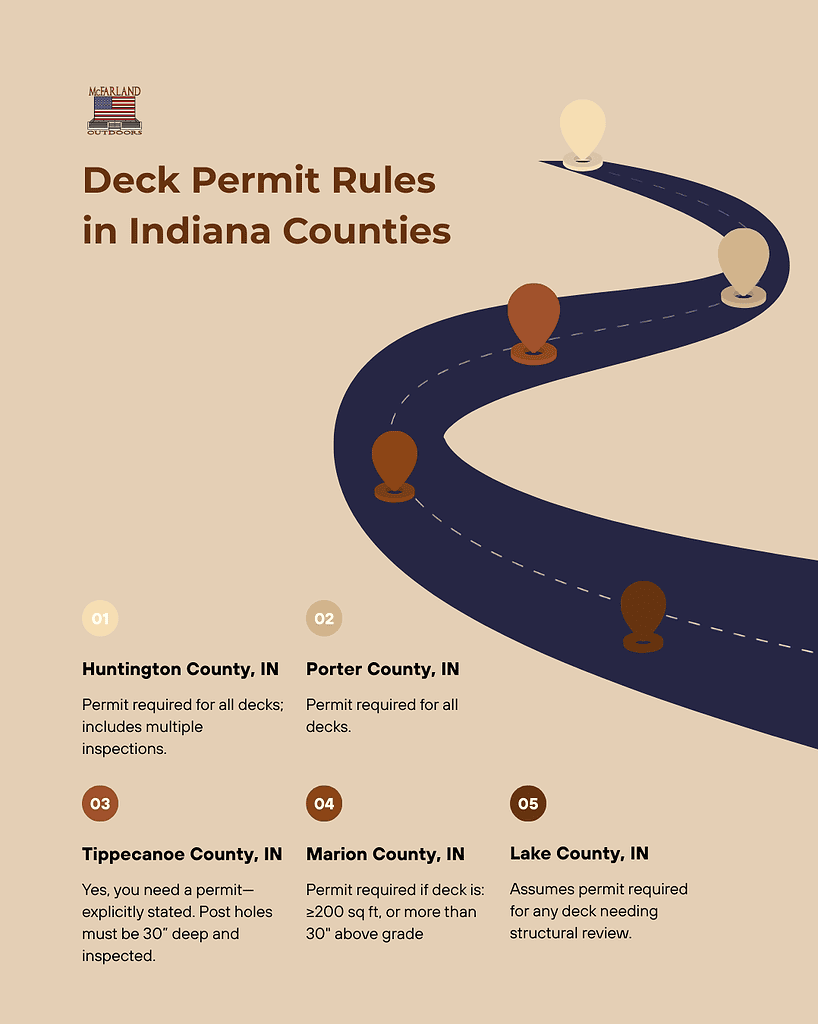
Porter County mandates permits for every new deck project and requires that any contractor performing the work be registered with the county. Footings must be placed at a minimum frost depth of 36 inches. County officials closely follow IRC construction standards during plan review and inspection.
Lake County, IN
Lake County primarily publishes structural and code standards for decks, and these guidelines operate under the assumption that any deck requiring structural review must go through the permit process. While they emphasize compliance with the IRC, local interpretations may add further requirements. Homeowners should expect to follow full code compliance for any new deck.
Lawrence, IN (Marion County)
The City of Lawrence requires a permit for decks that are either 200 square feet or larger, or more than 30 inches above grade. Projects meeting either threshold must go through the city’s approval process. Additionally, because Lawrence is within Marion County, an extra permit from the county is required as well.
Zionsville, IN
Zionsville requires a building permit for the construction of any residential deck, with no exemptions based on size or height. The city also demands detailed construction plans that clearly illustrate dimensions, structural components, and connections. Plan review is thorough, and deviations from approved plans are not allowed without resubmittal.
Hebron, IN
Hebron requires a permit for all new deck construction within town limits. Only registered contractors are allowed to perform permitted deck work, ensuring that the project meets local and IRC standards. The town expects full documentation of structural details before issuing approval.
Chesterton, IN
Chesterton mandates building permits for every deck project, including smaller residential installations. The application must include deck drawings, structural details, and footing information to ensure compliance with local building codes. Inspections are required at set stages to verify structural integrity.
Huntington County, IN
Huntington County requires permits for all decks and enforces a strict inspection schedule covering footings, framing, and final construction. Missing an inspection or performing unapproved work can result in fines or penalties. Compliance is taken seriously, and work may need to be uncovered or redone if reviews are bypassed.
Tippecanoe County, IN
Tippecanoe County is very clear that a permit is required for any deck construction. The county also specifies that post holes must be dug to a minimum depth of 30 inches and inspected before posts are set. These requirements ensure footings are below frost depth and structurally sound.
Westfield, IN
Westfield is a notable exception among Indiana municipalities, as it does not require permits for uncovered attached decks. However, if the deck is covered, enclosed, or intended to become living space, a permit becomes mandatory. Pergolas are also exempt from permitting unless they are structurally integrated into a larger addition.
| City/County | Permit Required? | Trigger / Threshold | Additional Notes |
|---|---|---|---|
| Crown Point, IN | Yes | Deck/patio over 12″ above finished grade | Permit required for any structural repair; guardrails required at 30″+ |
| Portage, IN | Yes | All decks, any size or height | Improvement Location Permit required; strict plan review + inspections |
| Porter County, IN | Yes | All decks | Contractors must be county-registered; footings must be 36″ deep |
| Lake County, IN | Yes (practically always) | Any deck needing structural review | Follows IRC closely; no explicit exemptions |
| Lawrence, IN (Marion County) | Yes | Deck is ≥200 sq ft OR >30″ above grade | Also requires a Marion County permit |
| Zionsville, IN | Yes | All decks | Extensive construction-plan requirements |
| Hebron, IN | Yes | Any new deck construction | Contractors must be registered |
| Chesterton, IN | Yes | All decks | Footing details, deck drawings, and inspections required |
| Huntington County, IN | Yes | All decks | Multiple inspections; fines for missed inspections |
| Tippecanoe County, IN | Yes | All decks | Post holes must be 30″ deep and inspected |
| Westfield, IN (Outlier) | No, for attached decks only | Permit NOT required for uncovered attached decks | Permit required if covered, enclosed, or converted to living space; pergolas exempt |
Zoning, Setbacks, and Easements: The Most Overlooked Part of Deck Permits
Beyond the building permit, almost every Indiana jurisdiction requires:
- Lot surveys
- Setback compliance
- Easement clearances
- Drainage considerations
- Septic/well distances (usually 10+ ft)
- HOA approvals (where applicable)
Decks illegally built in easements (utility, drainage, legal ditch) often must be torn out—no grandfathering.
Inspection Requirements Across Indiana
Most Indiana jurisdictions require:
1. Footing/Post-Hole Inspection
- Done before concrete is poured
- Must verify depth (30–36”) and diameter
2. Framing Inspection
- Beams, joists, hangers, connectors
- Ledger attachment
- Mechanical fastening
3. Final Inspection
- Decking
- Guardrails
- Stairs & handrails
- Flashing
- Clearances
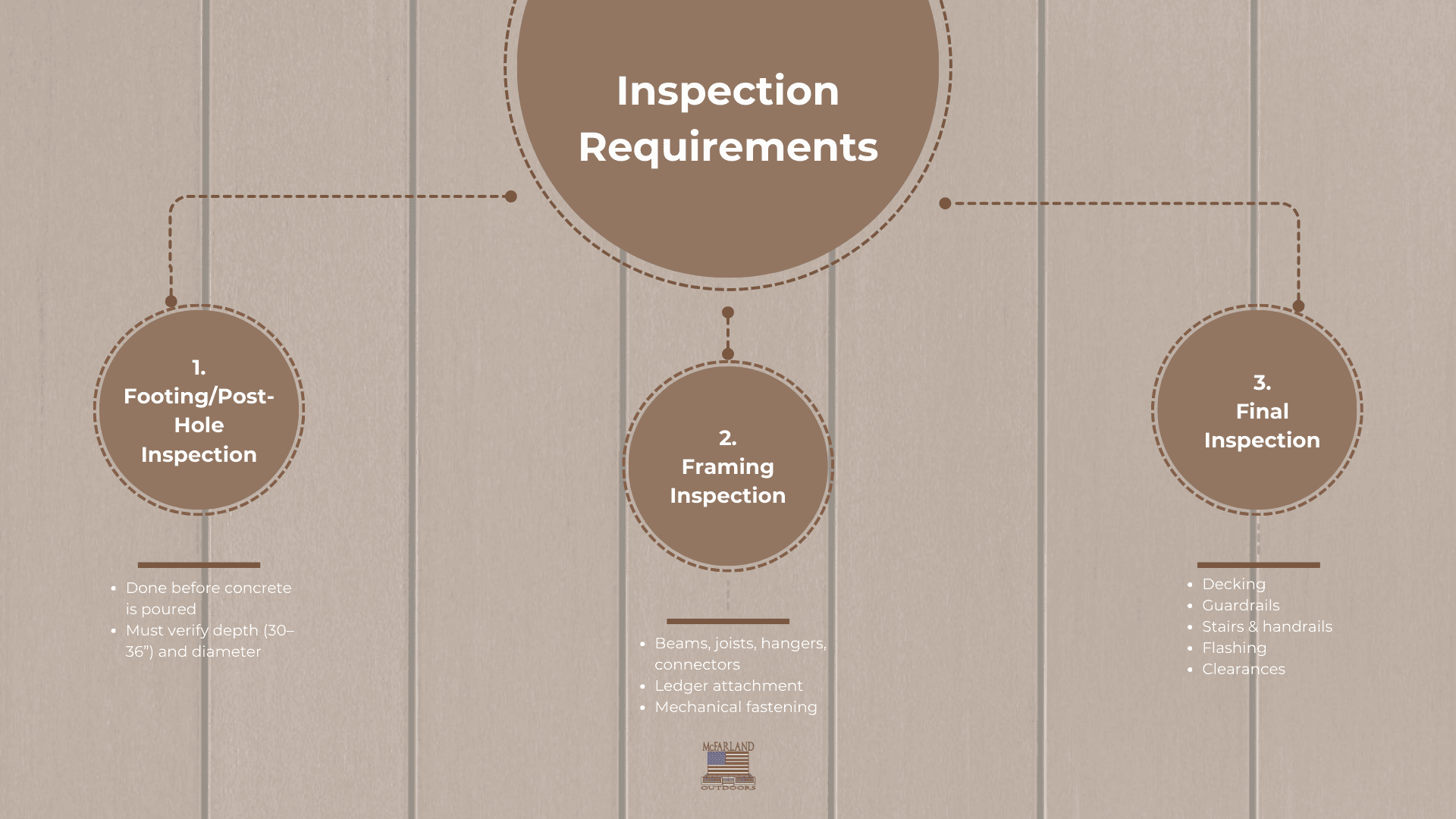
Missing inspections = fines, stop-work orders, or forced removal.
Common Permit Mistakes Indiana Homeowners Make
Here’s what building officials report most frequently:
- Building too close to property lines
- Attaching ledger to brick veneer
- Using non-rated fasteners
- Not extending footings below frost line
- Incorrect guardrail height or spacing
- Stairs failing rise/run requirements
- Deck built over an easement
- Starting work without approval
- Changing design without resubmitting plans
These mistakes account for over 70% of permit denials in many municipalities (according to local building departments).
Conclusion
In Indiana, the safest assumption is simple:
If you’re building a deck, you almost certainly need a permit.
Only a tiny minority of municipalities offer exemptions and even then, structural, zoning, and safety rules still apply.
To avoid fines, delays, and liability:
- Confirm your local city/township rules
- Review IRC requirements
- Pull a permit before digging
- Use compliant materials
- Schedule required inspections
- Document everything for future home buyers
A properly permitted deck protects your investment, your family’s safety, and your home’s resale value. If you found this guide for deck permit requirements in Indiana helpful, share it, or explore additional outdoor-construction resources at McFarland Outdoors.
Serving: Indianapolis • Carmel • Westfield • Noblesville • Greenwood • Bargersville • Zionsville
Sources
- https://crownpoint.in.gov/FAQ.aspx?QID=78
- https://lakecountyin.gov/departments/planning-commission/building-department-forms-c/forms/code%20requirements%20for%20design%20and%20construction%20of%20residential%20decks.pdf
- https://www.portagein.gov/DocumentCenter/View/959/Residential-Deck-Construction-Guide-PDF
- https://www.portercountyin.gov/DocumentCenter/View/149/Deck_Permit_Guide
- https://www.westfieldin.gov/FAQ.aspx?QID=69
- https://www.cityoflawrence.org/sites/default/files/document-group/DECKS.pdf
- https://zionsville-in.gov/DocumentCenter/View/305/Deck-Permit-Submittal-Information-
- https://www.hebronindiana.org/media/7406
- https://www.huntington.in.us/egov/documents/1636641454_57681.pdf
- https://www.chestertonin.org/DocumentCenter/View/863/Deck-Permit-Application
- https://www.tippecanoe.in.gov/FAQ.aspx?QID=147

Proven business leader with a strong track record of founding, growing, and scaling successful small businesses. Experienced in building companies from the ground up, driving sustainable growth, and leading teams through all stages of development. In the past year, led the delivery of 45+ custom deck projects. Skilled in identifying new business opportunities, developing and mentoring talent, and managing the full scope of daily operations—from sales and pricing strategy to financial oversight and execution. Known for operational excellence, strong financial acumen, and a continuous-improvement mindset that drives performance across every area of the business.