
If you’ve been researching backyard upgrades, you’ve likely come across the question: What is a floating deck?
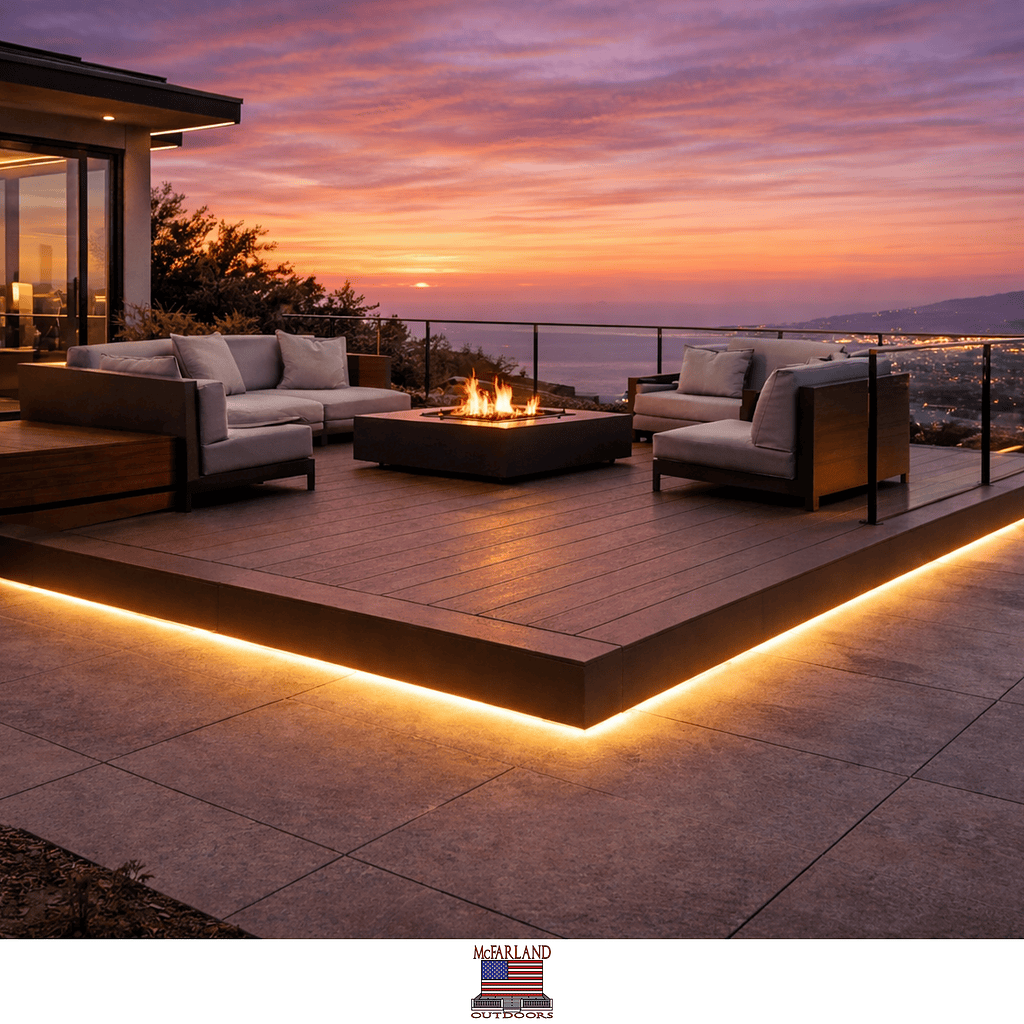
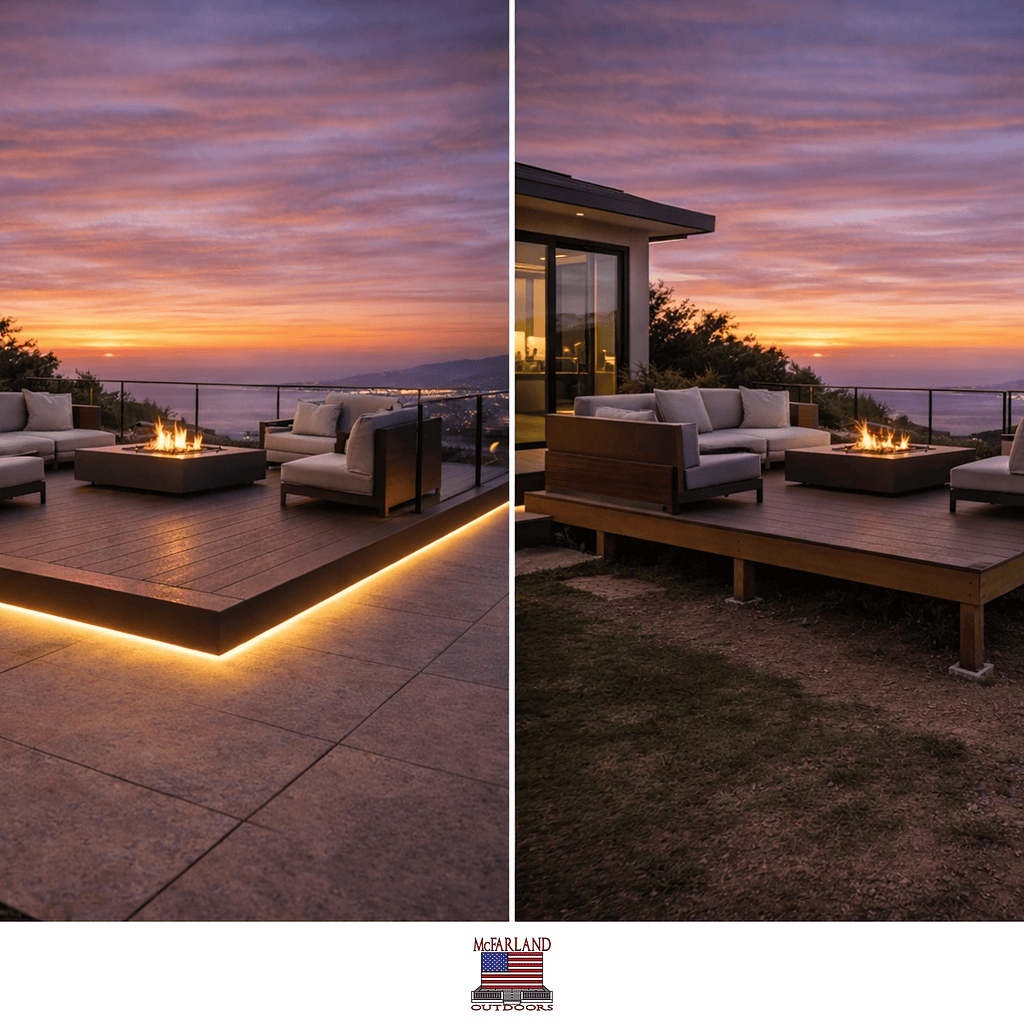
A floating deck is a freestanding deck that is not attached to your home. It is structurally independent, typically built low to the ground, and supported by surface blocks or footings rather than a ledger board connected to the house. Unlike traditional decks that bolt into your home’s framing, a floating deck transfers all of its weight directly into the ground below.
The term “floating” can be misleading. It does not mean unstable or temporary. It simply means the structure stands on its own. When built correctly with proper framing and foundation support, a floating deck is just as intentionally engineered as any other deck system. The key difference is independence. There is no ledger board connection, no load transferred into your home, and no reliance on your house for structural stability.
Most floating decks are built under 30 inches in height and function as patio-level gathering spaces. They are commonly used to define outdoor zones, create seating areas, or extend usable yard space without altering the home’s structure.
What Is a Floating Deck Design?
When homeowners ask what is a floating deck design, they are usually asking how it is built and how it works structurally.
At its core, a floating deck design includes a standard beam and joist framing system similar to a traditional deck. Pressure-treated lumber or engineered framing members form a grid. Deck boards are fastened on top. The structure is typically square or rectangular, and because it sits low to the ground, the overall profile remains minimal.
What makes the design different is how the load transfers. Instead of sending weight into a house through a ledger board, the deck’s beams rest on independent supports. These supports vary depending on soil conditions, climate, and desired longevity.
There are three common support approaches:
- Surface deck blocks, which sit on compacted gravel and allow for quick installation.
- Shallow concrete piers, which add stability and reduce minor settlement.
- Frost-depth footings, which extend below the frost line and provide the highest long-term structural reliability.
In mild climates, surface blocks may perform adequately. However, in freeze–thaw regions like Indiana, relying solely on surface blocks often leads to seasonal shifting. For homeowners seeking long-term stability, frost-depth footings are the smarter choice.
A properly designed floating deck remains low profile, independent, and structurally intentional. Simplicity does not mean weakness. It means the engineering is focused entirely on soil interaction rather than home integration.’
Floating Deck vs Fixed Deck: Structural Differences That Matter
The debate between floating deck vs fixed deck is not about appearance. It is about structural behavior and long-term performance.
A floating deck is not attached to the house. A fixed deck is connected to the home with a ledger board and properly flashed to prevent water intrusion. Floating decks rely entirely on independent footings, while fixed decks require frost-depth footings and structural ties into the home’s framing.
Floating decks avoid the risk of ledger board rot and flashing failure. However, they are more susceptible to soil movement because all weight transfers directly to the ground. Fixed decks distribute some load into the home, increasing lateral stability and structural rigidity.
When it comes to load capacity, floating decks are generally best suited for patio-level use and moderate furniture loads. Fixed decks are better for heavier features such as hot tubs, masonry fireplaces, outdoor kitchens, or large pergolas.
Settlement risk also differs significantly. Floating decks move if the soil moves. Fixed decks still rely on soil stability, but their connection to the house can reduce noticeable movement.
Drainage planning is critical in both systems. Fixed decks require proper ledger flashing and waterproofing to protect the home. Floating decks require careful grading to prevent water pooling beneath the frame.
Choosing between the two depends on elevation, soil conditions, and long-term plans.
Are Floating Decks a Good Idea?
This is the question homeowners ultimately care about: are floating decks a good idea?
The honest answer is yes, in the right context.
Floating decks are a good idea when the structure is low to the ground, the soil drains well, and you are not planning to add heavy structural features. They work exceptionally well as patio extensions, defined outdoor seating areas, or backyard entertainment zones. When properly built on stable soil with adequate drainage, they provide a cost-effective and visually clean solution.
However, floating decks are not ideal in every scenario. They are not the best option if the deck will be elevated significantly off the ground, if you want multiple levels, or if you plan to integrate heavy structural elements. They are also less ideal in regions with aggressive freeze–thaw cycles unless frost-depth footings are used.
Floating decks excel as lifestyle enhancements. They are not always the best choice for long-term structural expansion.
How Freeze–Thaw Cycles Impact Floating Decks in Indiana
This is where many online guides stop short.
In Indiana and other cold-climate states, freeze–thaw cycles play a major role in deck performance. When water in the soil freezes, it expands. This process, known as frost heave, lifts the soil upward. When temperatures rise, the soil settles again. This repeated movement can cause noticeable structural shifting.
For floating decks supported by surface blocks, frost heave can lead to:
- Uneven deck surfaces.
- Tilted beams.
- Minor frame racking.
- Stair shifting or separation.
- Seasonal slope changes.
Even a half-inch shift at one support point can create visible unevenness across the deck surface.
Frost-depth footings solve this problem by extending below the active frost layer. Soil beneath that depth remains stable year-round. This dramatically reduces movement and long-term settlement.
If you are building in a freeze–thaw climate and want minimal maintenance, frost-depth footings are not overkill. They are strategic.
Do Floating Decks Require Permits?
Permit requirements vary by municipality, but floating decks often fall into more lenient categories.
In many regions, decks under 30 inches high may be exempt from full permitting requirements. However, setbacks from property lines, HOA rules, and size limitations still apply. Some municipalities require permits regardless of attachment type.
Never assume exemption. Always verify locally before construction begins. Avoiding a permit upfront can create expensive compliance issues later.
Cost Comparison: Floating Deck vs Fixed Deck
From a cost perspective, floating decks typically require less excavation, fewer materials, and less labor. They are faster to build and involve no ledger flashing or home integration.
Fixed decks require deeper footings, ledger board installation, structural reinforcement, and additional labor. The upfront investment is higher.
However, lifecycle thinking matters. Lower initial cost does not automatically equal better long-term value. If a floating deck requires periodic re-leveling due to soil movement, maintenance costs accumulate over time.
In some cases, investing more upfront in deeper footings can reduce structural adjustments later.
Common Problems With Poorly Built Floating Decks
The majority of floating deck failures are not design flaws. They are preparation flaws.
Common issues include:
- Surface block settlement due to poor compaction.
- Water pooling beneath the frame from improper grading.
- Hidden frame rot caused by constant moisture exposure.
- Lateral sway from inadequate bracing.
- Improperly anchored stairs that shift seasonally.
- Wind uplift risk in unsecured framing systems.
Deck boards may look pristine while the framing underneath deteriorates. The visible surface is not the structural story. Proper ground preparation and drainage planning determine long-term success.
When We Recommend Floating Decks (And When We Don’t)
We recommend floating decks when the goal is to create a patio-level gathering space that defines an outdoor zone without altering the home’s structure. They are ideal for stable soil conditions, moderate use, and homeowners seeking a cost-conscious backyard upgrade.
We recommend fixed decks when elevation increases, when multi-level builds are desired, or when integrated features such as pergolas, kitchens, or roof structures are planned. Fixed decks are also better suited for homeowners prioritizing long-term resale value and structural permanence.
The right choice is contextual. It depends on elevation, soil, intended load, and long-term goals.
Final Thoughts: Choosing the Right Deck Structure
Understanding what is a floating deck is only the beginning. The real decision lies in how that structure interacts with your soil, climate, and intended use.
Floating decks offer independence, simplicity, and flexibility. Fixed decks offer rigidity, integration, and long-term structural reinforcement.
The correct decision depends on elevation, drainage, soil stability, and how you plan to use the space five, ten, or twenty years from now.
Planning the structure correctly from the start prevents costly rebuilds later. If this guide helped clarify your options, share it with someone planning an outdoor project or explore related resources to continue your research.

Proven business leader with a strong track record of founding, growing, and scaling successful small businesses. Experienced in building companies from the ground up, driving sustainable growth, and leading teams through all stages of development. In the past year, led the delivery of 45+ custom deck projects. Skilled in identifying new business opportunities, developing and mentoring talent, and managing the full scope of daily operations—from sales and pricing strategy to financial oversight and execution. Known for operational excellence, strong financial acumen, and a continuous-improvement mindset that drives performance across every area of the business.