
Most deck safety articles start with advice.
This one starts with evidence.
Decks are often portrayed as inherently dangerous structures—but the data tells a more precise story. When deck failures happen, they are rarely random. They follow clear, repeatable patterns tied to age, construction methods, and connection details.
This article breaks down what deck safety statistics actually show, what they don’t, and why most serious deck incidents are predictable long before they occur.
What the Data Says About Deck Safety (And What It Doesn’t)
Public perception around deck safety is shaped by headlines—sudden collapses, large crowds, dramatic images. These incidents are real, but they are also statistical outliers.
What the data does show:
- The vast majority of decks never experience a structural failure
- Most deck-related injuries are not caused by collapse
- Failures cluster around a small number of known conditions
What the data does not support:
- The idea that decks are unsafe by default
- The assumption that material choice alone determines safety
- The belief that failures occur without warning
Statistics matter because they reveal patterns, and deck safety is fundamentally about pattern recognition.
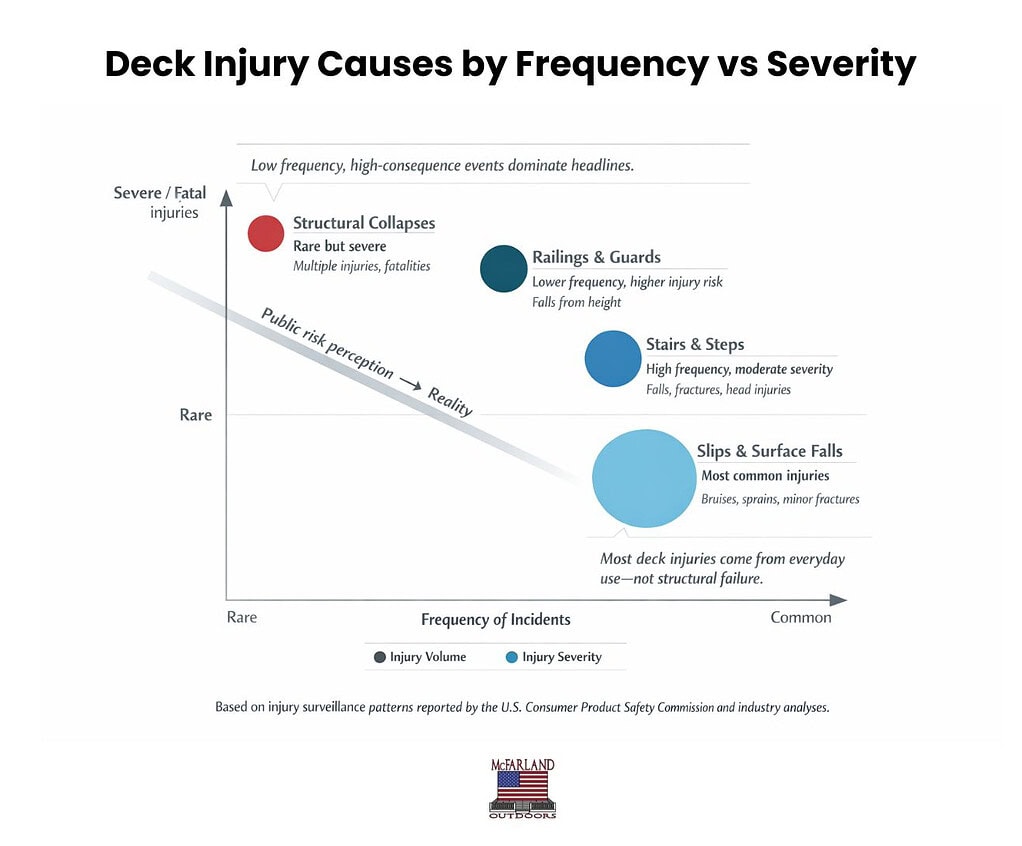
How Often Do Deck-Related Injuries Actually Occur?
According to injury surveillance data from the Consumer Product Safety Commission, an estimated 6,000–6,500 people per year in the U.S. are treated in emergency departments for injuries related to decks, porches, and balconies.
That number needs context.
Injury distribution trends:
- Slips and falls on walking surfaces account for the majority
- Stairs and steps are a major secondary contributor
- Railings and guards represent a smaller but notable share
- Structural collapses are rare—but produce the most severe outcomes
The key insight is not how often injuries occur, but how they occur. Most deck injuries are low-height, non-structural incidents. Collapses are uncommon, but when they happen, injuries escalate rapidly.
Age Is the Biggest Deck Safety Risk Factor
Across multiple industry assessments, age consistently outperforms material type as a risk indicator.
Estimates from the North American Deck and Railing Association suggest that more than half of residential decks in the U.S. are past their original design life.
Typical lifespan ranges:
- Poorly detailed or minimally maintained decks: 10–15 years
- Code-compliant decks with proper detailing: 20–30+ years
- Decks with upgrades and periodic repairs: often longer
The safety gap is not “old vs new” wood.
It’s pre-code vs post-code construction, and whether aging decks were ever upgraded to reflect modern standards.
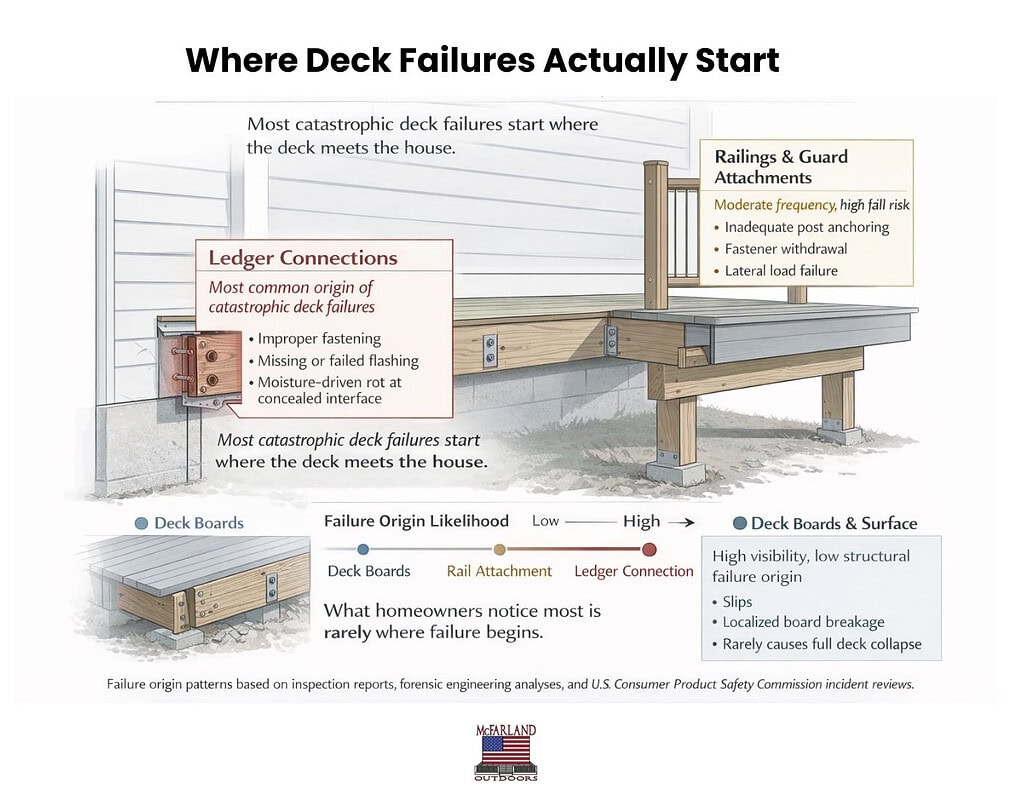
Where Structural Deck Failures Actually Start
Collapse investigations are remarkably consistent.
The most common initiating failure is not the decking surface, not the joists, and not the posts. It is the deck-to-house connection.
Dominant failure points:
- Ledger board attachment
- Fastener corrosion or withdrawal
- Missing or inadequate flashing
- Lack of lateral load resistance
Across documented failures:
- Deck boards almost never cause collapse
- Material species is rarely the root cause
- Failures are driven by connection design and detailing
In short: decks don’t usually fail because materials “wear out.”
They fail because forces were never managed correctly.
How Modern Building Codes Changed Deck Safety Outcomes
Modern deck safety outcomes improved sharply once codes aligned with failure data.
Updates in the International Residential Code and related prescriptive guidance introduced:
- Mandatory ledger flashing
- Defined fastener spacing and embedment
- Lateral load connectors to resist pull-away forces
- Higher guardrail load requirements
These changes target the exact failure mechanisms seen in collapse investigations.
As a result:
- Newer decks fail less often
- Failures are more localized when they occur
- Progressive collapse risk is significantly reduced
Code is not bureaucracy—it’s institutionalized injury prevention.
The Most Common Non-Collapse Deck Safety Incidents
While collapses dominate public attention, they account for a small fraction of injuries.
The data shows that everyday deck safety incidents are far more common:
- Slips on wet, icy, or contaminated surfaces
- Stair geometry and attachment issues
- Loose or under-designed railings
- Poor lighting at transitions and edges
A deck can be structurally sound and still unsafe to use.
Deck safety is not a single condition—it’s a system.
What Deck Safety Statistics Actually Support
When analyzed together, deck safety data supports several clear conclusions:
- Most deck incidents are preventable
- Construction quality outweighs material choice
- New decks are statistically safer than old ones
- Failures repeat the same patterns across decades
- Safety improves dramatically with proper detailing and upgrades
Deck safety is not guesswork.
It is predictable risk management.
Where a Deck Safety Checklist Fits Into the Data
A deck safety checklist is not a maintenance routine—it’s a risk-filtering tool. The data consistently shows that serious deck incidents originate from a narrow set of conditions: ledger connections, fasteners, railings, stairs, and moisture-related decay.
An effective deck safety checklist focuses attention on these statistically dominant failure points, helping identify predictable risk early, before it escalates into injury or collapse. Importantly, checklists do not replace professional evaluation; they surface conditions that data repeatedly links to incidents, aligning inspection effort with real-world risk rather than cosmetic wear.
Where Inspections Fit Into the Data (Brief)
Inspection exists because decks fail quietly before they fail visibly.
Statistically:
- Early detection of connection and railing issues sharply reduces collapse risk
- Most serious failures show warning signs long before an incident occurs
Inspections don’t create safety on their own.
They interrupt predictable failure paths while correction is still possible.
Final Takeaway: Deck Safety Is Predictable
Decks are not inherently dangerous structures. When failures occur, the data shows they are rarely the result of chance or everyday use. Risk increases with age, not activity, and serious incidents tend to follow the same repeatable patterns over time.
Modern construction methods and updated building codes have measurably improved performance, proving that safety outcomes are driven by design, detailing, and execution—not luck or material alone. Deck safety is cumulative, built through systems that work together rather than reliance on any single component. Understanding where risk actually originates—and acting before it compounds—is what prevents incidents. That’s what the numbers make clear.

Proven business leader with a strong track record of founding, growing, and scaling successful small businesses. Experienced in building companies from the ground up, driving sustainable growth, and leading teams through all stages of development. In the past year, led the delivery of 45+ custom deck projects. Skilled in identifying new business opportunities, developing and mentoring talent, and managing the full scope of daily operations—from sales and pricing strategy to financial oversight and execution. Known for operational excellence, strong financial acumen, and a continuous-improvement mindset that drives performance across every area of the business.