
Can you build an outdoor kitchen on a deck? Yes—but only if the deck was designed or upgraded to handle it. Most decks aren’t.
An outdoor kitchen introduces permanent, concentrated weight, sustained heat, and utility demands that standard decks were never built for. While a deck may feel solid underfoot, that has little to do with its ability to support built-in grills, cabinetry, or stone surfaces over time. Failures rarely happen all at once—they develop quietly through deflection, heat damage, and overstressed connections.
This guide focuses on structural reality, not design trends. It explains when building an outdoor kitchen on a deck is viable, when it requires reinforcement, and when it’s the wrong choice entirely.
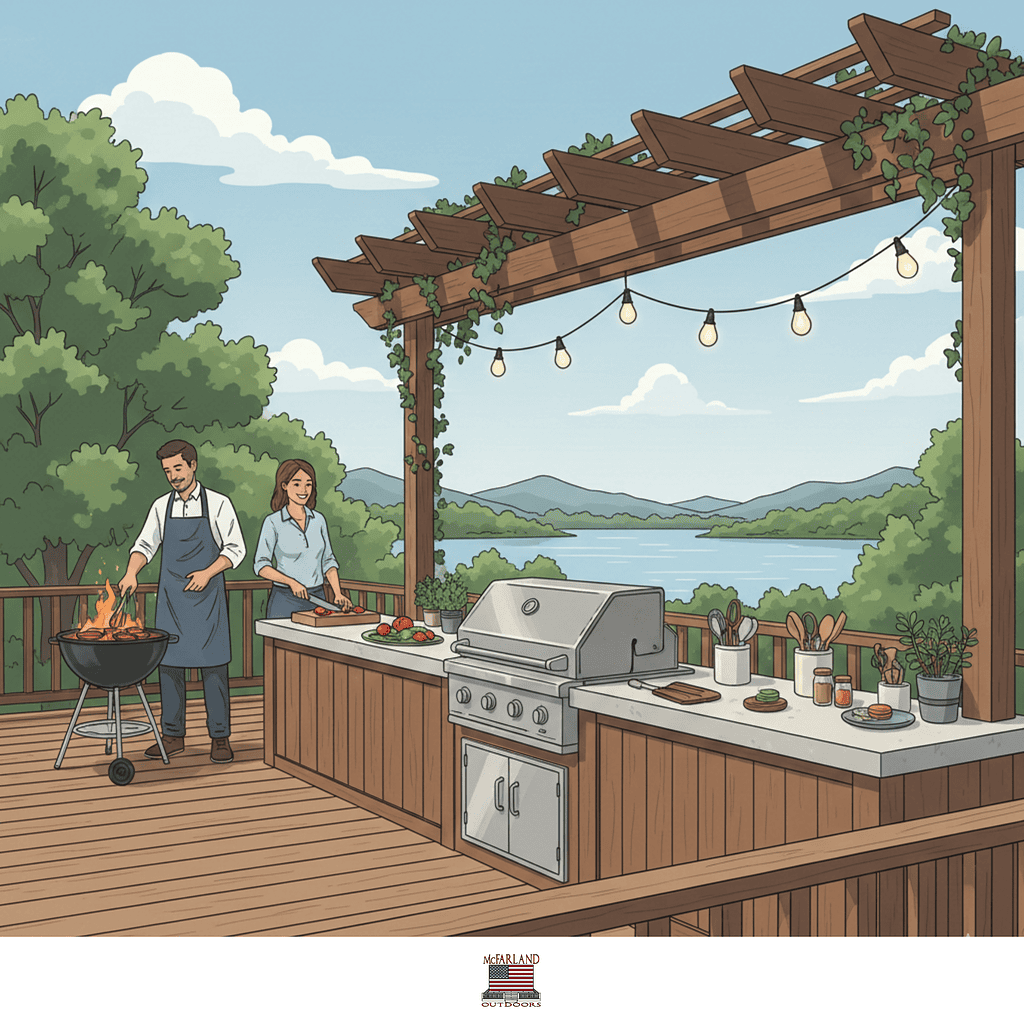
Why Outdoor Kitchens Stress Decks More Than Homeowners Expect
Most people underestimate outdoor kitchens because they mentally compare them to a grill. That comparison is wrong.
Static loads vs. concentrated loads
A deck is typically designed for distributed live loads—people, furniture, foot traffic. An outdoor kitchen introduces concentrated dead loads that sit in one place permanently.
A rolling grill spreads weight across multiple points.
A built-in island focuses weight into a small footprint—often directly over a few joists.
That difference alone changes everything.
Why grills ≠ kitchens
- A freestanding grill might weigh 150–250 lbs.
- A built-in grill on a deck, combined with cabinetry, cement board, stone veneer, and countertops, can exceed 1,000–2,000 lbs—before snow load is added.
Why stone, masonry, and cabinets change everything
Stone and masonry don’t just add weight; they add rigidity. Decks are flexible systems. When rigid elements are placed on flexible frames, movement concentrates at fasteners and joints, accelerating failure.
Raised decks vs. ground-level decks
- A raised deck behaves like a suspended floor system.
- A ground-level deck behaves closer to a platform.
That distinction matters so much it deserves its own section—early, not buried at the end.
Deck Load Capacity — The Make-or-Break Factor
This is where most bad decisions begin.
Typical deck ratings
Most residential decks are designed for:
- 40 psf live load (people, furniture)
- 10 psf dead load (decking, framing)
Some jurisdictions allow 50 psf total. That’s not generous. It’s conservative for normal use—not kitchens.
Why kitchen islands exceed this
Outdoor kitchen components stack loads:
- Appliance weight
- Cabinet framing
- Cement board
- Stone or porcelain surfaces
- Stored items
- Snow accumulation (Indiana reality)
These loads are permanent and concentrated, not temporary.
Live load + dead load + snow = failure math
In Indiana, snow load isn’t hypothetical. Add wet snow sitting on counters and appliances, and suddenly the deck is carrying loads it was never designed to handle.
Why “it feels sturdy” is meaningless
Decks don’t fail like chairs. They fail slowly:
- Joists overstress
- Beams deflect
- Fasteners loosen
- Railings shift
- Inspection failures show up years later
By the time you feel it, the damage is already done.
Structural problems like these are often identified during a professional deck inspection checklist before major upgrades are attempted.
Decision gate
If your deck was not designed for a kitchen, stop.
Reinforce, redesign, or relocate the kitchen.
Outdoor Kitchen on a Raised Deck vs. Ground-Level Deck
Outdoor Kitchen on a Raised Deck (High-Risk Zone)
This is where most failures happen.
Key risks:
- Concentrated loads over long spans
- Posts and beams not aligned under the kitchen zone
- Vibration from foot traffic and appliance use
- Long-term deflection you won’t notice until it’s permanent
When reinforcement works:
- Additional beams directly under the kitchen
- Posts aligned to footings, not just blocking
- Reduced joist spacing (often 12″ OC or tighter)
- Steel hardware and upgraded connections
Reinforcement often requires additional posts tied into proper deck footing types so the load transfers safely to the ground.
When it doesn’t:
- Cantilevered sections
- Undersized joists
- Decks designed only for seating
- Second-story decks with limited footing capacity
A raised deck with a kitchen is possible—but it’s never casual.
Outdoor Kitchen on a Ground-Level Deck
This is safer, but still conditional.
Why it performs better:
- Shorter spans
- Less deflection
- Easier reinforcement
What still matters:
- Proper footings
- Drainage to prevent moisture trapping
- Airflow under appliances
- Fire separation from framing
A ground-level outdoor kitchen on a deck can work well—if it’s treated as a structural project, not a décor upgrade.
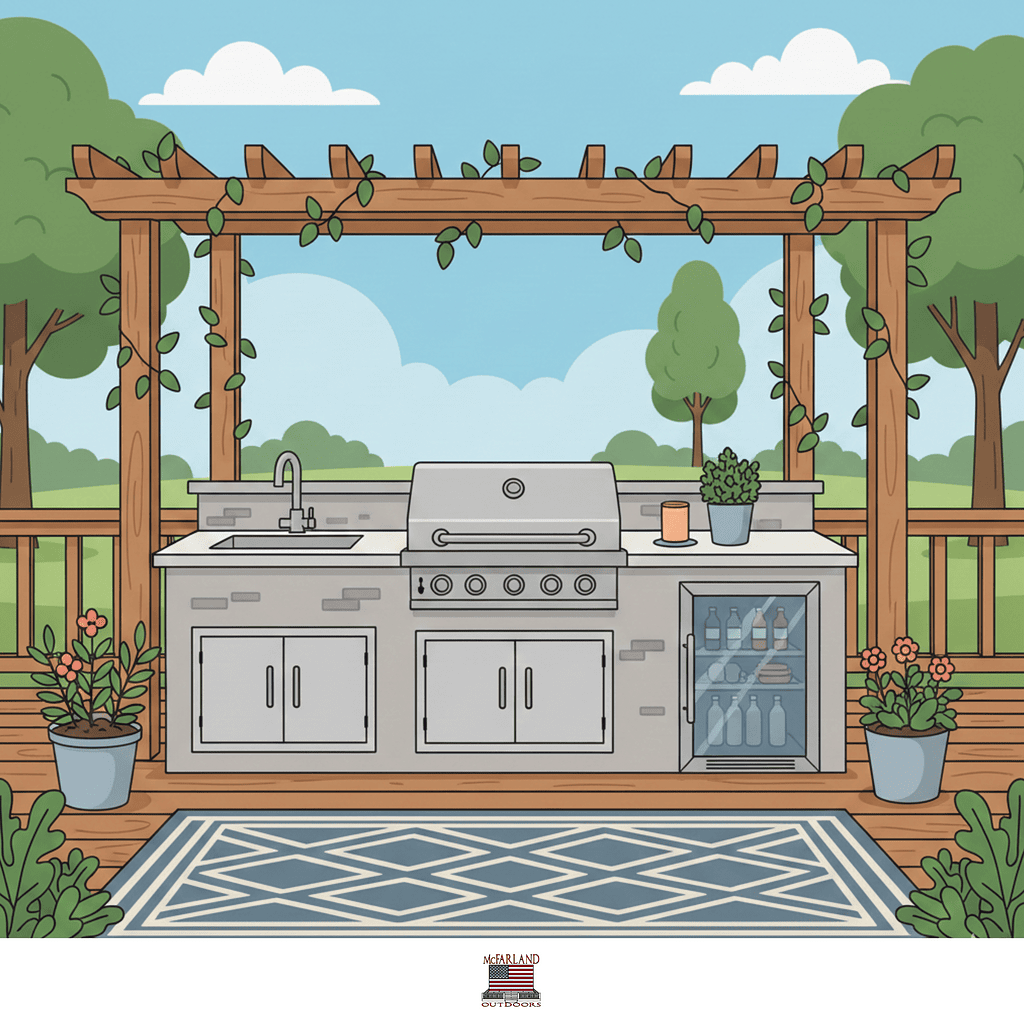
Built-In Grill on a Deck — What Changes Structurally
A built-in grill isn’t just a heavier grill. It’s a structural event.
Built-in vs. freestanding
Freestanding grills move. Built-ins don’t.
That single difference turns a deck into a load-bearing system for an appliance.
Why masonry bases are the biggest problem
Masonry concentrates weight and resists movement. Decks flex. That mismatch causes stress at:
- Fasteners
- Joist hangers
- Beam connections
Grill jackets, heat zones, and clearances
Most built-in grills require insulated jackets and minimum clearances. These aren’t suggestions—they’re there to prevent heat transfer into framing.
Why “lightweight” kits still overload framing
Even modular kits stack materials. “Lightweight” doesn’t mean “structurally insignificant.”
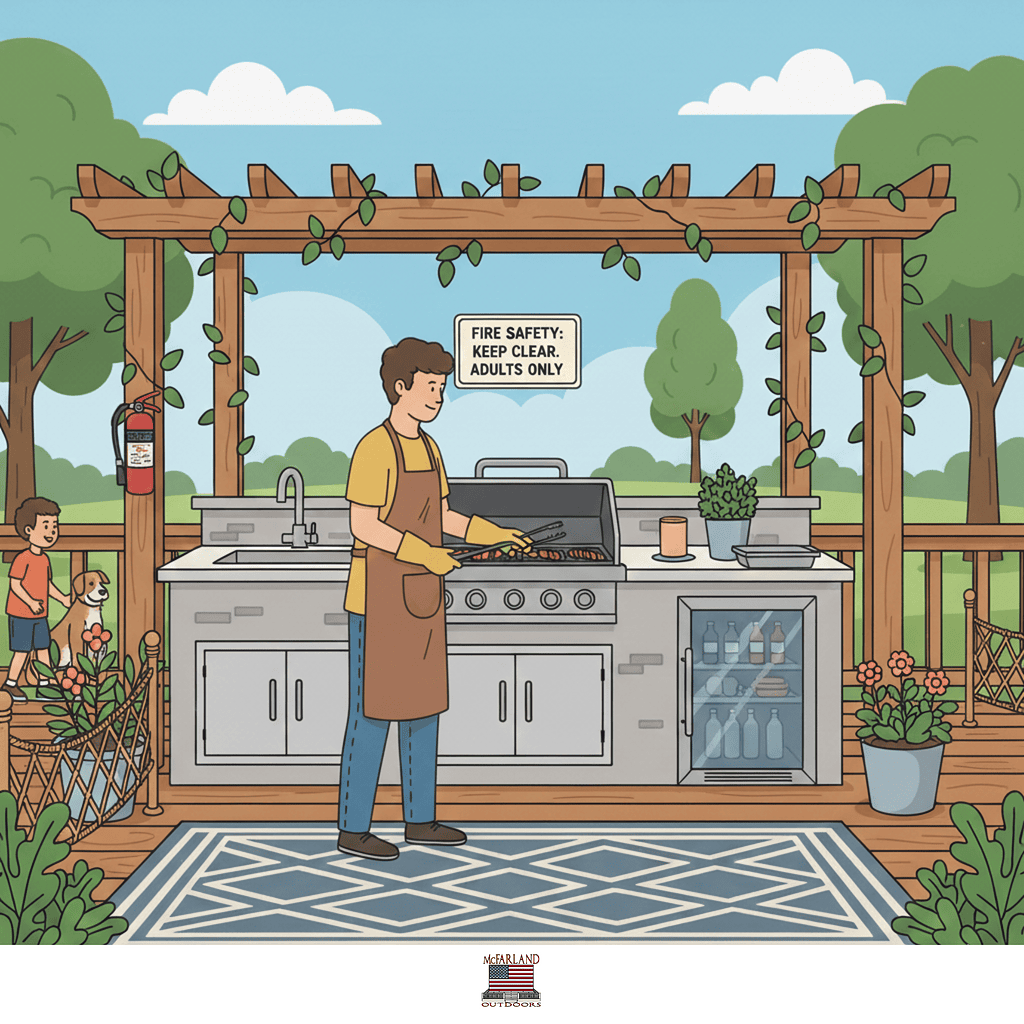
Fire Safety on Deck Kitchens
Fire risk isn’t about flames alone—it’s about heat over time.
Wood vs. composite vs. PVC
- Wood: chars, dries, ignites
- Composite: softens, deforms, can ignite
- PVC: resists moisture but reacts poorly to high heat
No decking material is immune.
Heat damage vs. ignition
Many deck failures aren’t fires—they’re heat damage that weakens materials until something else fails.
Why grill mats are not a solution
Grill mats protect surfaces, not structure. Heat radiates sideways and downward.
Railing and vertical clearance failures
Railings and overhead structures trap heat and smoke. This is one of the most common design mistakes on a deck with kitchen layouts.
Utilities on a Deck Kitchen (Gas, Electric, Water)
This is where “simple” projects explode in complexity.
Gas line routing risks
Gas lines must avoid heat zones and movement points. Decks move more than slabs.
GFCI and electrical code realities
Outdoor kitchens require weather-rated components and protected routing. Shortcuts fail inspections.
Why sinks escalate everything
Water introduces drainage, freeze protection, and structural penetrations. Many deck kitchens fail here.
Permit implications homeowners ignore
Once utilities are involved, deck permit requirements typically apply to ensure structural and safety compliance. Unpermitted work hurts resale and insurance.
These projects must also comply with Indiana deck building codes, especially when structural upgrades or utility installations are involved.
When a Deck Kitchen Is a Bad Idea (Hard Stops)
No negotiation here.
- Undersized joists
- Cantilevered decks
- Old or rotting frames
- Second-story decks without structural upgrades
- DIY “extra blocking” myths
If any of these apply, don’t force it.
Smarter Alternatives That Perform Better Long-Term
Sometimes the smartest move is changing the layout—not fighting physics.
Deck + patio hybrid
Dining and circulation on the deck, kitchen on a slab.
Kitchen adjacent to the deck
Same experience, better performance.
Step-down kitchen zones
Visually connected, structurally separate.
Why resale favors this approach
Inspectors trust slabs. Buyers do too.
How to Build an Outdoor Kitchen on a Deck (If It Passes All Tests)
If you’re still green-lit, do it correctly.
- Engineering first — no exceptions
- Framing upgrades — beams, posts, spacing
- Load-path planning — weight goes somewhere; decide where
- Appliance-first layout — design around heat and weight, not aesthetics
- Inspection sequencing — structural approval before finishes
This is how professionals avoid expensive rebuilds.
Conclusion
An outdoor kitchen on a deck can work—but only when the structure beneath it is engineered for the load, heat, and long-term stress involved. Decks built for seating and foot traffic often lack the strength in the deck framing system required for permanent kitchen installations.
The right approach starts with structural evaluation, not appliance selection. When a deck can’t be responsibly reinforced, alternatives like adjacent slabs or hybrid layouts deliver better performance and fewer long-term risks. If a deck kitchen is going to succeed, it will do so because the structure was addressed first — an essential part of overall deck structural safety.

Proven business leader with a strong track record of founding, growing, and scaling successful small businesses. Experienced in building companies from the ground up, driving sustainable growth, and leading teams through all stages of development. In the past year, led the delivery of 45+ custom deck projects. Skilled in identifying new business opportunities, developing and mentoring talent, and managing the full scope of daily operations—from sales and pricing strategy to financial oversight and execution. Known for operational excellence, strong financial acumen, and a continuous-improvement mindset that drives performance across every area of the business.