
If you want the blunt truth, here it is: most deck failures don’t start with boards, railings, or stairs — they start underground. Footings are invisible once the deck is built, which is exactly why they’re ignored, rushed, or undersized. When they’re wrong, decks don’t usually collapse overnight. They settle. They shift. They twist out of level. Then — often years later — they fail inspection, fail structurally, or fail during use.
This guide exists to cut through the noise and explain the types of deck footings that actually determine whether a deck lasts or becomes a liability. You’ll learn what a deck footing really does, how different footing systems perform under real loads and real soil conditions, and which options work — or quietly fail — in Indiana’s climate. This isn’t a product roundup or a typical deck material comparison, and it’s not DIY optimism. The goal is simple: help you choose a footing strategy that passes inspection, resists frost and soil movement, and still performs decades after the surface materials are replaced.
Why Footings — Not Boards or Railings — Cause Most Deck Failures
Deck boards wear out. Railings loosen. Those are maintenance issues. Footings are structural — and directly impact overall structural deck safety.
When footings fail, the deck:
- Moves out of level
- Pulls away from the house
- Develops cracked connections
- Transfers stress into posts, beams, and fasteners
According to the International Code Council (IRC) and local Indiana deck building codes, footing depth, diameter, and bearing surface are the primary determinants of deck stability — not the decking material itself. Inspectors know this. Engineers know this. Homeowners usually learn it too late.
In Indiana especially, the combination of freeze–thaw cycles, clay-heavy soils, and moisture makes footing mistakes unforgiving. A deck can look perfect for five years and still be structurally compromised underneath.
Indiana-Specific Risk Factors You Can’t Ignore
Indiana decks fail for predictable reasons:
- Frost heave: Footings that don’t extend below the frost line are lifted each winter, then settle unevenly in spring.
- Clay soil: Clay expands when wet and contracts when dry, exerting lateral and vertical pressure on footings.
- Inspection standards: Local inspectors routinely flag undersized diameters, shallow depths, and non-approved footing systems.
- Moisture retention: Poor drainage accelerates soil movement and post deterioration, especially when under-deck drainage systems are not properly planned.
If your footing choice doesn’t account for these realities, it’s not conservative — it’s careless.
What Is a Deck Footing? (Clear, Inspector-Level Definition)
A deck footing is the structural element that transfers the combined weight of the deck—dead load (structure) and live load (people, furniture, snow)—into the soil safely and permanently.
Footing vs. Pier vs. Post vs. Foundation
- Footing: The base below grade that bears directly on soil.
- Pier: A vertical extension above the footing, often concrete.
- Post: The vertical framing member that supports beams.
- Foundation: The complete system transferring load to the ground.
Footings work through compression (bearing weight) and uplift resistance (preventing the deck from being pulled upward by frost, wind, or structural forces). When footings are too small, too shallow, or placed in unstable soil, the deck doesn’t “settle naturally”—it moves unpredictably.
The 5 Main Types of Deck Footings (Ranked by Real-World Use)
This is a decision framework—not a neutral list.
1. Poured Concrete Footings (The Code Standard)
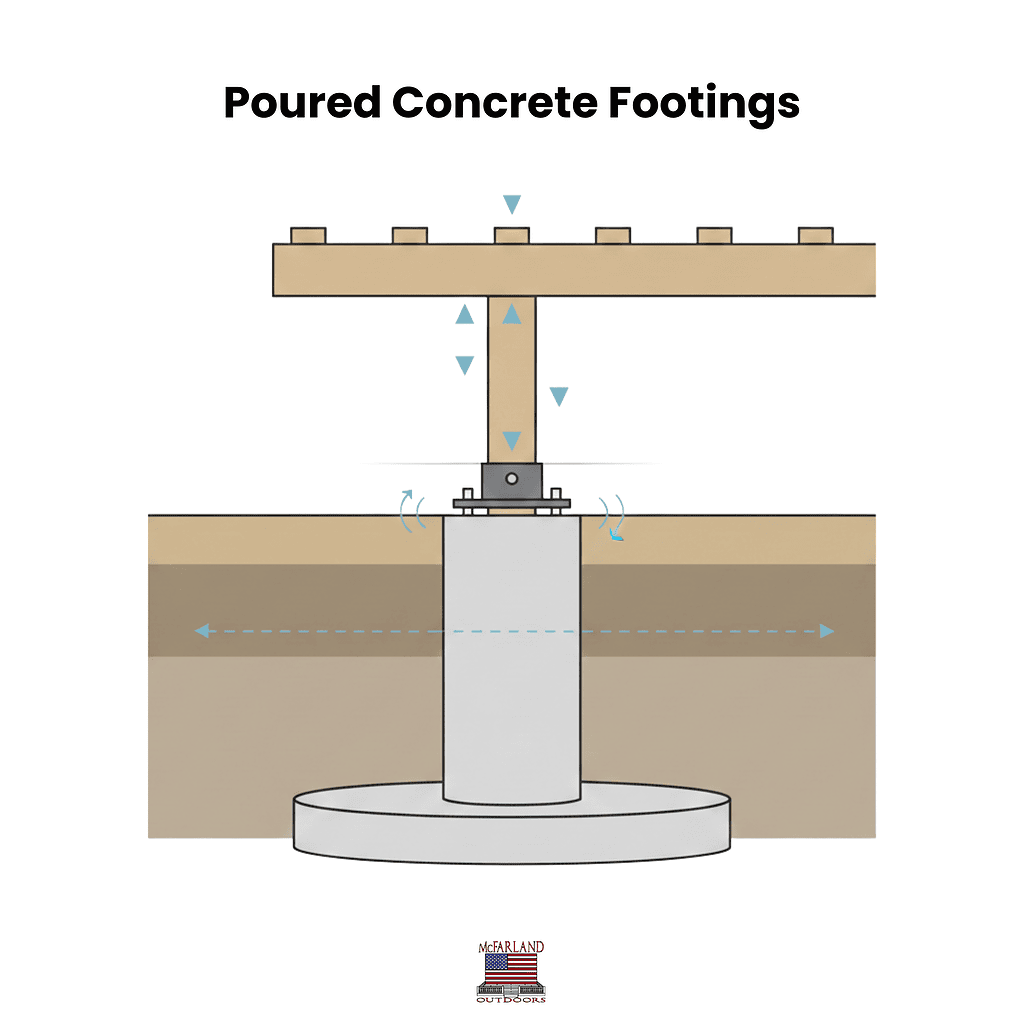
How they’re built: Holes are excavated below the local frost line, sized according to load, and filled with concrete to create a wide bearing surface. Posts are attached with approved brackets to keep wood above grade.
When they’re required:
- Attached decks
- Elevated decks
- Heavy loads (hot tubs, outdoor kitchens, pergolas)
Pros in Indiana:
- Predictable performance in clay soil
- Widely accepted by inspectors
- High compressive strength and durability
Cons:
- Labor-intensive excavation
- Weather-dependent curing
- Permanent (adjustments are difficult later)
Common inspection failures:
- Footings too shallow
- Diameter too small for tributary load
- Poor soil compaction at base
Bottom line: When installed correctly, poured concrete remains the most reliable, inspector-approved footing option.
2. Helical Piles (Screw Piles)
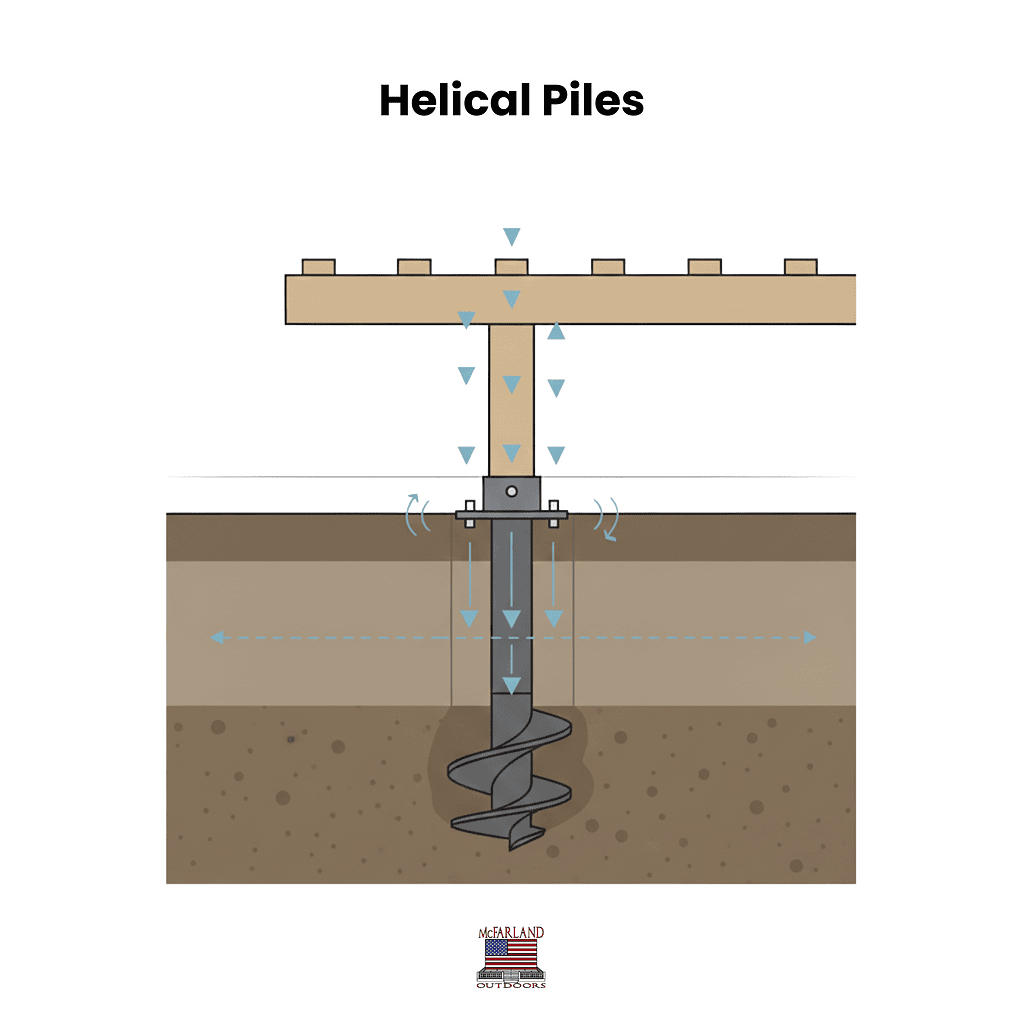
What they are: Steel shafts with helical plates screwed into the ground using hydraulic equipment. They’re load-rated during installation and resist both compression and uplift.
Ideal conditions:
- Poor or variable soil
- Tight access sites
- Winter builds
- Sloped or erosion-prone terrain
Cost vs. performance: Higher upfront cost, but immediate load capacity and minimal soil disturbance.
Why they’re growing in Indiana: Shorter build seasons, unpredictable soil, and the need for engineered solutions.
When they’re overkill: Small, low decks on stable, well-drained soil.
Bottom line: Not cheap, but structurally excellent where soil conditions are uncertain.
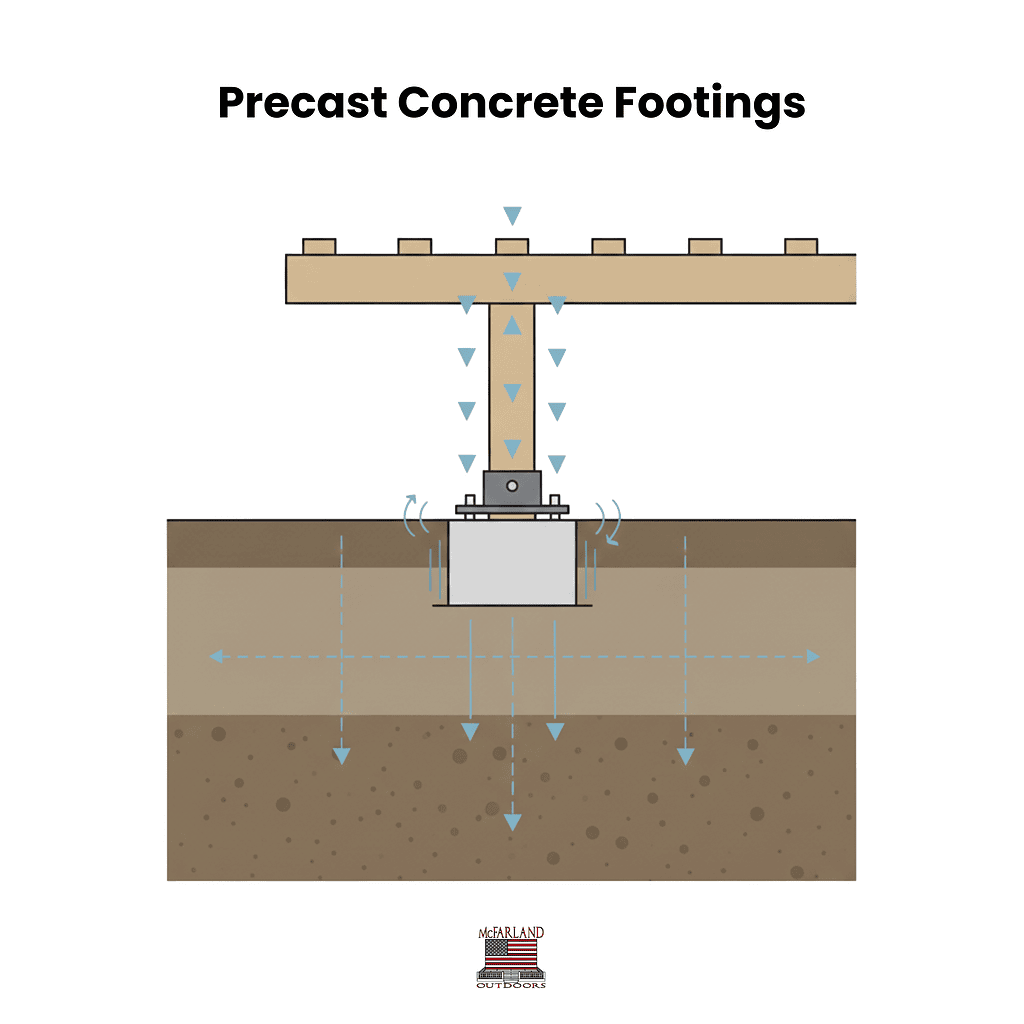
3. Precast Concrete Footings / Piers
Often confused with deck blocks—incorrectly.
What they are: Factory-poured concrete piers, sometimes reinforced with rebar, placed on prepared bases.
When inspectors allow them:
- Small to medium decks
- Proper soil preparation
- Correct spacing and load limits
Load limits and soil dependency: They rely heavily on soil stability. In clay-heavy areas, long-term performance is inconsistent.
Why they fail on clay sites: Seasonal expansion and contraction undermine bearing surfaces.
Bottom line: Viable in controlled conditions, risky as a default solution.
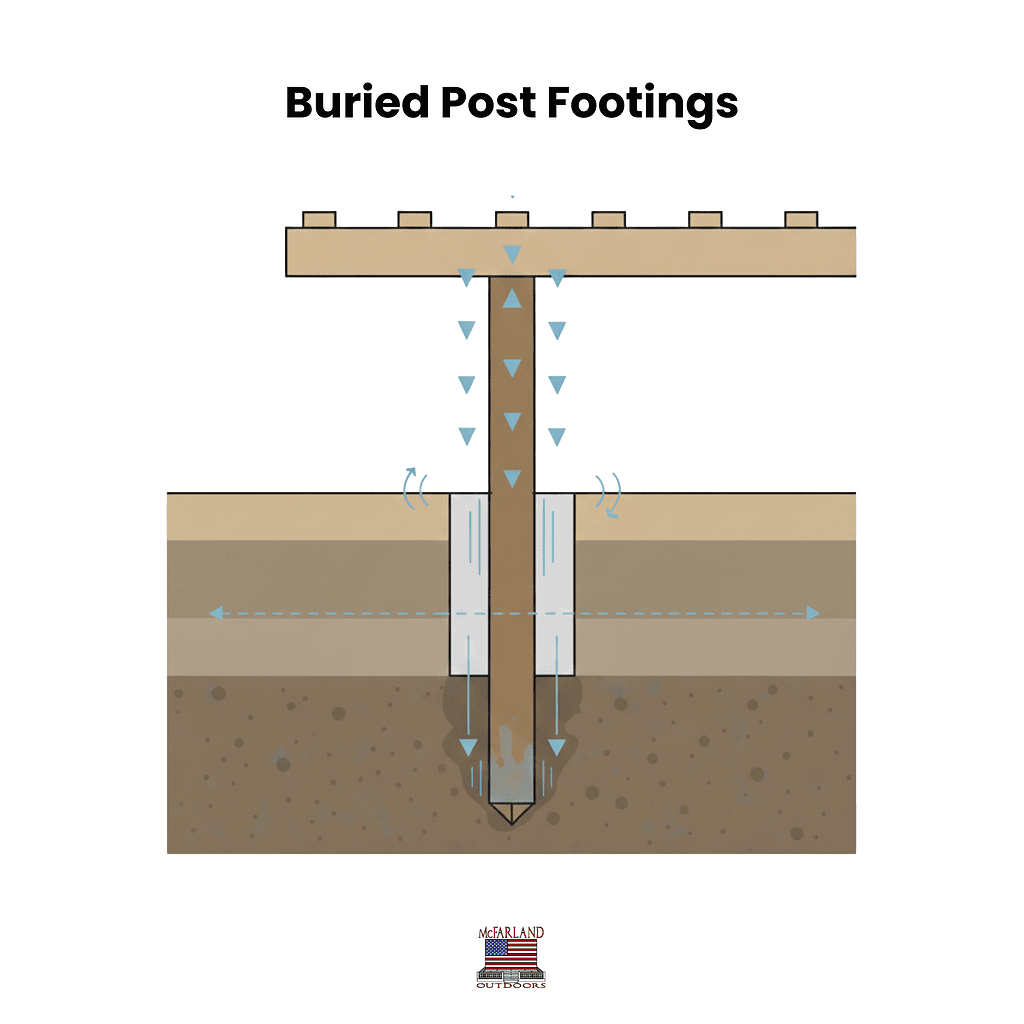
4. Buried Post Footings (Why Pros Avoid Them)
How they’re built: Posts embedded directly in concrete below grade.
The reality: Wood in contact with soil will rot. Not might—will.
Where they still appear:
- Older construction practices
- Cost-driven builds
- DIY projects unaware of long-term risk
Bottom line: Predictable decay, shorter lifespan, increasing code resistance. Avoid when longevity matters.
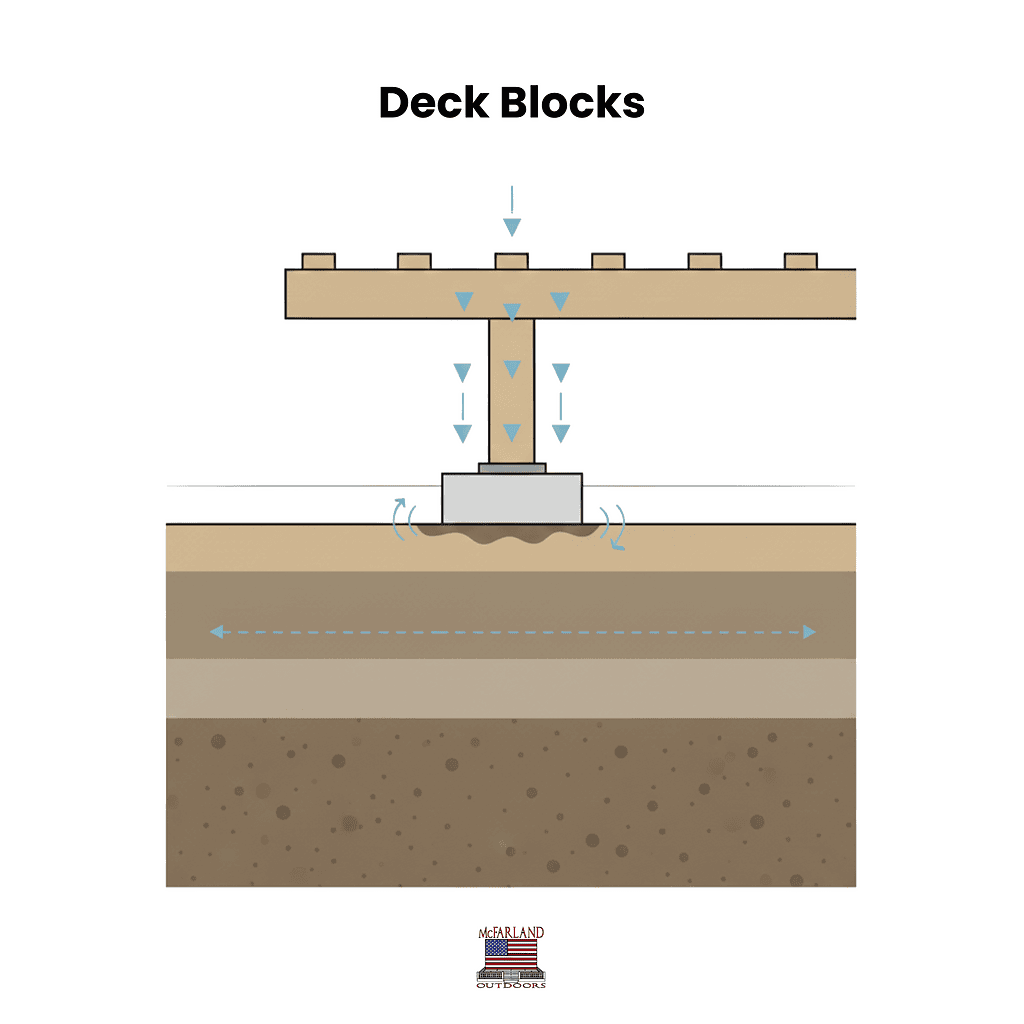
5. Deck Blocks (Use With Extreme Caution)
What they’re actually for:
- Very small
- Floating
- Non-attached decks
Where they’re commonly illegal:
- Attached decks
- Elevated decks
- Frost-prone regions
Why they fail under freeze–thaw cycles: No frost protection, limited bearing area, high susceptibility to movement.
Bottom line: Temporary solutions masquerading as foundations.
Deck Footings That Commonly Fail Inspection in Indiana
Inspectors consistently flag:
- Footings above frost depth
- Undersized diameters
- Improper soil bearing
- No uplift resistance
- Mismatched footing type to deck height or load
Inspection failures are rarely subjective — they’re measurable, which is why using a deck inspection checklist before inspection can prevent avoidable issues.
How Soil Type Changes the Right Footing Choice
- Clay: Expands and contracts aggressively; demands deep, wide footings.
- Sandy: Drains well but requires proper sizing to prevent settlement.
- Loamy: Ideal, but still requires frost protection.
- Rocky: Often favors drilled concrete or helical piles.
One-size-fits-all footing advice fails because soil behavior isn’t uniform.
How Deck Height and Load Dictate Footing Requirements
- Ground-level decks ≠ elevated decks
- Hot tubs and outdoor kitchens multiply loads dramatically
- Tributary load (the area supported by each footing) determines diameter and spacing
Underestimate load, and every component above suffers.
Deck Footings vs. Piers (Clearing Up the Confusion)
Sometimes footings and piers are part of the same system. Sometimes they’re not. Inspectors care about terminology because permits depend on it, especially when navigating deck permit requirements in Indiana. Mislabeling components can delay approval or force redesigns.
How Many Deck Footings Do You Need?
- Typical spacing: 6–8 feet on center
- Beam size and load dictate spacing
- Adding footings is cheaper than correcting structural movement later
More support is almost always the conservative—and economical—choice.
DIY vs. Professional Footing Installation (Hard Truth)
DIY is reasonable for:
- Small, ground-level decks
- Simple layouts
- Stable soil
DIY becomes risky when:
- Deck height increases
- Loads increase
- Soil becomes unpredictable
Footing mistakes are the most expensive deck mistakes to fix. This is why choosing a deck contractor with experience in soil conditions and code compliance matters more than most homeowners realize.
Conclusion
There is no universal “best” solution—only the footing that correctly matches soil conditions, deck height, load requirements, and Indiana’s climate. In practice, understanding the types of deck footings is what separates durable, code-compliant decks from structures that slowly fail out of sight. For most permanent decks, that reality points to poured concrete footings or engineered pile systems. Other options can work, but only within strict limitations and with inspection considerations planned in advance.
If safety, longevity, and resale value matter, stop chasing shortcuts. Evaluate the footing system first, choose the right option for the conditions, and build second. Everything above grade depends on what’s holding the deck up underground.

Proven business leader with a strong track record of founding, growing, and scaling successful small businesses. Experienced in building companies from the ground up, driving sustainable growth, and leading teams through all stages of development. In the past year, led the delivery of 45+ custom deck projects. Skilled in identifying new business opportunities, developing and mentoring talent, and managing the full scope of daily operations—from sales and pricing strategy to financial oversight and execution. Known for operational excellence, strong financial acumen, and a continuous-improvement mindset that drives performance across every area of the business.