
Most pergola failures aren’t caused by “extreme weather.” They’re caused by misunderstood wind limits and bad inMost pergola failures aren’t caused by “extreme weather.” They’re usually the result of misunderstood wind limits and poor installation. Wind doesn’t need to be dramatic to cause damage—it just needs to expose weak points.
In real conditions, pergolas vary more than people expect. A poorly anchored structure can start failing around 30–40 mph, which isn’t unusual in everyday storms. Standard residential pergolas typically hold up in the 50–70 mph range. Engineered, professionally installed systems can withstand 80–100+ mph, often aligning with local building codes.
That gap comes down to execution, not luck. Wind resistance depends far more on design and anchoring than material alone. Two pergolas made from the same material, in the same city, can perform completely differently under the same wind.
That’s the part most articles avoid.
Why Wind Speed Alone Is Misleading
Most people ask how much wind a pergola can withstand as if it’s a single number. It isn’t.
Wind speed (mph) is what you hear in forecasts. It gives a general idea of conditions, but it doesn’t reflect the actual stress on a structure. What matters is wind load (psf)—the force applied to surfaces.
Wind also doesn’t act in one direction. It creates multiple stresses at the same time.
Lateral force pushes posts sideways and tests their stability.
Uplift force pulls upward, often exposing weak anchoring.
Racking force twists the frame, gradually throwing it out of alignment.
Engineers account for all of this using standards based on ASCE wind load principles. You don’t need the math, but ignoring these forces is where failures start.
The key point is simple: wind speed alone doesn’t determine performance. Size, height, exposure, and—most importantly—anchoring define how a pergola actually holds up.
That’s why two pergolas on the same street can face the same storm and have completely different outcomes.
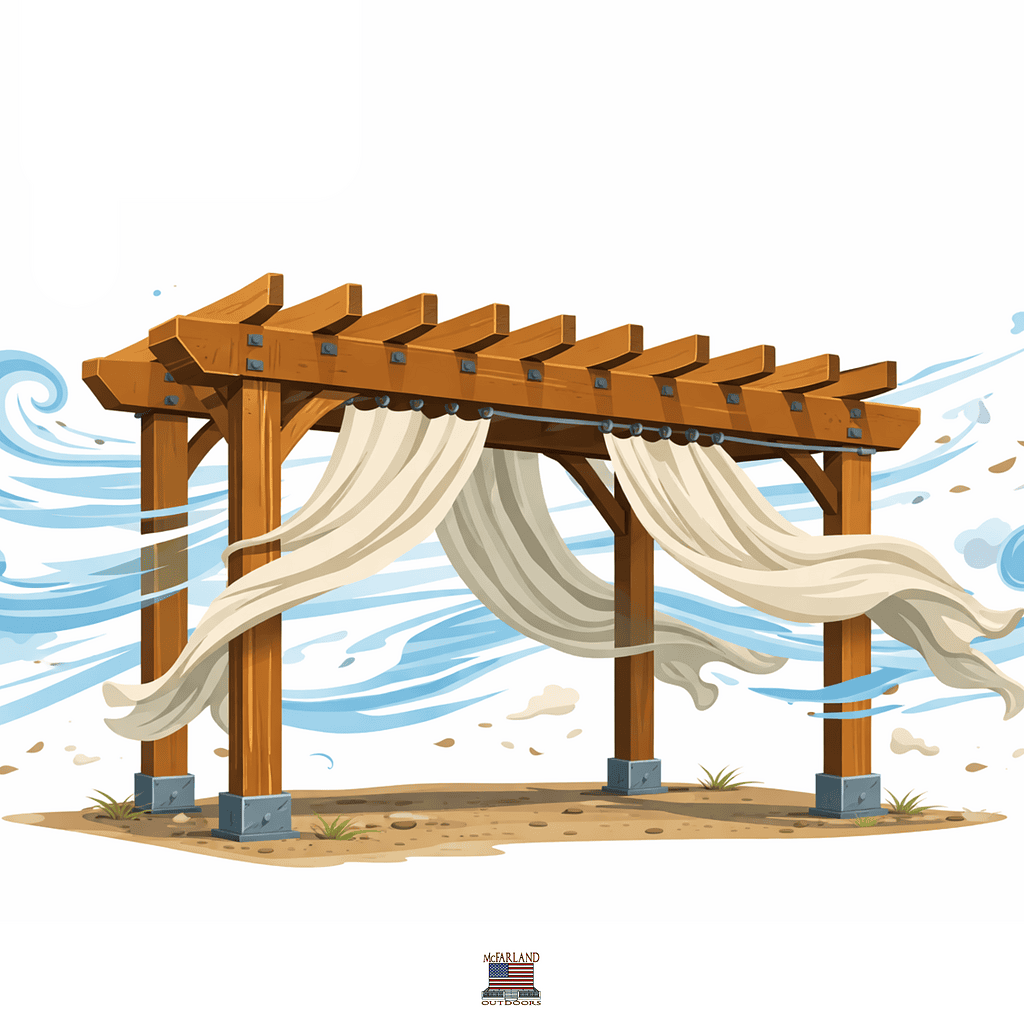
Pergola Wind Rating vs Real-World Performance
HoMost homeowners look for a clear “wind rating” when choosing a pergola. The problem is, that number rarely exists in a meaningful, code-certified way.
Pergolas aren’t factory-tested systems. They’re assembled on-site, and every variable—from soil conditions to installation quality — changes how they perform. A pergola installed on compacted soil with deep footings behaves very differently from one bolted to a shallow deck frame.
Manufacturers often publish wind-related claims, but these typically reflect controlled scenarios: individual component testing, ideal anchoring, and perfectly executed installations. That’s not how real projects play out.
In practice, performance depends on what happens in the field. Soil strength, mounting method (deck vs ground), post depth, and connection hardware all shape how the structure handles stress. Cut corners in any of these areas, and the “rated” performance quickly becomes irrelevant.
That’s why many pergolas that look fine on paper fail during their first serious storm. The rating wasn’t wrong—it just didn’t reflect reality.
Pergola Wind Loads Explained (Without the Engineering Jargon)
Wind load is simply the force wind applies to a structure as speed increases. It’s not just about how fast the wind blows, but how much pressure builds against surfaces.
At around 60 mph, the stress is usually lateral — pushing the structure sideways. Poorly braced pergolas often start to shift or rack at this point. By 80 mph, uplift becomes a serious issue, especially for shallow footings or deck-mounted posts that lack proper anchoring.
Once you approach 100 mph, the weak point often shifts to connections—bolts, brackets, and joints begin to fail before the main structure does.
Scale changes everything. Wind load doesn’t increase in a straight line. As pergolas get larger, the forces grow exponentially. A wide, solid roof can behave like a sail, catching and amplifying wind pressure. In contrast, an open rafter design allows air to pass through, significantly reducing stress.
That single design choice can determine whether a pergola survives or fails under the same conditions.
How Pergola Design Affects Wind Resistance
Design decisions have a bigger impact on wind performance than most material choices, especially when comparing patio cover and pergola designs. Small differences in layout or structure can dramatically change how forces are distributed.
Open vs. Solid Roof
Open rafters reduce wind resistance by allowing airflow through the structure. Solid roofs—especially fixed panels—trap wind and create uplift, which puts more demand on footings and connections. Louvered systems sit in between: when open, they behave like rafters; when closed, they act more like a solid surface.
Freestanding vs. Attached
Attached pergolas generally perform better because they share structural load with the main building. This reduces lateral movement and lowers the risk of overturning. Freestanding designs don’t have that advantage—they must resist all forces independently, which makes proper anchoring critical.
Height, Span, and Post Sizing
Larger pergola size increases leverage under wind pressure, increasing stress at the base. Longer spans introduce more racking risk, especially if beams or connections are undersized. Post size also matters more than most people assume—a 6×6 post offers significantly better resistance to both lateral forces and uplift than a 4×4, particularly in exposed areas.
Put simply, design isn’t just aesthetic. It directly determines whether a pergola holds its shape—or comes apart when conditions turn against it.
Wind Resistance by Pergola Material
Material plays a role in wind resistance — but it’s not the deciding factor most people assume. Structural behavior under wind load is driven more by design, connections, and anchoring than by the material itself.
Wood, Aluminum, Steel, and Vinyl
Wood pergolas offer solid compressive strength, which makes them stable under vertical loads. The weak point is usually at the connections. Without proper brackets, bolts, or reinforcement, joints loosen over time and become vulnerable under lateral stress.
Aluminum pergolas are lighter and naturally corrosion-resistant, which makes them popular in modern installations. But that reduced weight means they rely heavily on secure anchoring. If the base isn’t properly fixed, the structure becomes easier to lift or shift under strong winds.
Steel pergolas provide the highest structural strength, especially for larger spans. The trade-off is that they demand properly engineered footings. Without that, the strength of the frame is wasted because the failure point shifts to the base.
Vinyl pergolas are often misunderstood. On their own, they lack structural strength. They only perform well when reinforced internally — typically with aluminum or steel cores that handle the load.
Fabric and Sail Structures
Fabric or sail-style pergolas operate differently. They’re designed to work with tension, not resist force. In storm conditions, they must either be removed or properly tensioned. Left loose, they act like a sail and dramatically increase uplift forces.
Bottom line: material strength is secondary. Without proper anchoring and connection design, even the strongest pergola will fail under pressure.
Anchoring: The #1 Reason Pergolas Fail in Wind
Most pergola failures trace back to anchoring. Not design, not material—anchoring.
The most common mistakes are predictable: relying on surface brackets alone, using shallow concrete footings, or attaching posts to deck boards that were never meant to carry structural loads. These shortcuts may look fine initially, but they fail under real wind stress.
What Proper Anchoring Actually Looks Like
A pergola built to handle wind load starts below ground. Footing types need to be sized appropriately for both the structure and local wind conditions. That typically means deeper, wider concrete bases—not minimal pours.
Post bases should either be embedded directly into concrete or secured with engineered connectors designed to resist uplift and lateral movement. Hardware matters here; light-duty brackets simply don’t hold under sustained force.
Deck-Mounted Pergolas: Where Most Fail
Mounting a pergola on a deck is where things often go wrong. If you’re planning on incorporating a pergola with your deck, structural preparation becomes critical. It only works if the load transfers into the deck’s structural framing — not just the surface boards.
That requires proper blocking between joists, secure through-bolting into beams, and a clear plan for handling uplift forces. Skip any of that, and the deck itself becomes the weak point. This is also why broader deck safety considerations matter when adding structural loads like pergolas. When failure happens, it’s usually not subtle — the entire system gives way.
Can Pergolas Withstand High Winds in Storm-Prone Areas?
Yes—but only within realistic limits.
Pergolas are designed to handle typical outdoor conditions, not extreme weather events. The type of wind matters just as much as the speed.
Different Wind Types, Different Risks
Thunderstorms often produce short, sharp gusts that cause sudden racking — twisting the structure out of alignment.
Straight-line winds apply sustained pressure, gradually testing connections and anchoring.
Gusts, in general, are the most destructive. They create rapid spikes in force that exceed average wind speeds and catch structures off guard.
In open terrain — like suburban developments or flat regions — gust factors are higher. Measured data shows that peak gusts can exceed forecasted wind speeds by 20–30% or more, which is often where failures occur.
What to Expect in Reality
A well-built pergola can withstand strong winds, but it’s not a storm-proof structure. It’s designed to survive weather, not resist extreme events indefinitely.
Understanding that distinction matters. When expectations are realistic — and the installation is done properly — pergolas perform reliably. Ignore either one, and failure becomes a matter of when, not if.
Building Codes, Permits, and Wind Load Requirements
Permits for pergolas are more common than most homeowners expect — especially once the structure moves beyond a simple open frame. If the pergola is roofed, attached to a house, or exceeds certain size thresholds, it typically falls under local building code requirements.
Those codes aren’t arbitrary. Wind load requirements are calculated based on several factors, including exposure category (open terrain vs sheltered areas), overall structure height, and roof configuration. A pergola in an open yard will face significantly higher wind pressure than one protected by surrounding buildings or trees.
The bigger issue is misunderstanding what “no permit required” actually means. It doesn’t mean the structure is safe — it usually means no one has reviewed the design. In practice, that shifts the responsibility entirely onto the builder or homeowner, often without the engineering knowledge needed to assess wind performance properly.
How to Make a Pergola More Wind-Resistant
If Improving wind resistance isn’t about one upgrade—it’s about reinforcing the entire system so forces are distributed and resisted properly.
Structural Reinforcement
Start with the foundation. Deeper, properly sized footings are one of the most effective ways to improve stability under both lateral and uplift forces. Pair that with larger posts — typically 6×6 or greater — and you immediately increase the structure’s ability to resist movement.
Adding cross-bracing or using rigid frame designs further reduces racking. This is especially important in areas exposed to consistent wind, where even small amounts of movement can weaken connections over time.
Reducing Wind Exposure
Design also plays a role. Reducing roof surface area — either by using open rafters or limiting solid coverage — can significantly decrease uplift forces. Strategic placement helps as well. Positioning a pergola near a house or other structure can break wind flow and reduce direct exposure.
Landscaping, such as hedges or windbreaks, can offer some benefit. But it’s important to be realistic — these are secondary measures. They don’t replace structural reinforcement.
DIY Pergola Kits vs Professional Installation (Wind Perspective)
DIY pergola kits can work — but only within a narrow set of conditions.
Most kits are designed around ideal assumptions: stable soil, low wind exposure, and precise assembly. They rarely account for real-world variables like local wind loads, deck limitations, or uplift forces that become critical during storms.
Where DIY Works
For smaller, open-roof pergolas in sheltered environments, a well-installed kit can perform adequately. The key is staying within those limits and not overestimating what the system can handle.
Where It Breaks Down
As soon as you move into larger spans, solid or louvered roofs, or wind-prone areas, those assumptions fall apart. The structure starts to behave differently under load, and the margin for error disappears.
That’s where professional design becomes essential. Not because it’s overkill — but because it accounts for the forces most DIY setups ignore.
Frequently Asked Questions
Can pergolas withstand high winds?
Yes—when they’re properly designed and anchored. A well-built pergola can handle strong winds without issue, but that depends entirely on how it’s installed. Weak footings or poor connections will fail long before the material does.
What wind speed will damage a pergola?
There’s no single threshold, but patterns are clear. Poor installations often start failing around 30–40 mph, especially under gust conditions. Professionally engineered systems can withstand significantly higher loads, often exceeding 80 mph when built to code.
Are aluminum pergolas stronger than wood?
Not by default. Aluminum is lighter and more corrosion-resistant, while wood offers better compressive strength. But neither determines performance on its own. Connection quality and anchoring have a far greater impact than the material choice.
Can a pergola blow over?
Yes—and when it happens, uplift is usually the cause. Wind gets underneath the structure, creating upward force that pulls posts out of their footings. This is especially common with shallow anchors or deck-mounted setups that aren’t designed for uplift resistance.
Should pergolas be removed before storms?
Permanent pergolas aren’t meant to be removed. However, adjustable features—like louvers or fabric covers—should be secured or opened to reduce wind resistance. Ignoring that step often increases stress on the structure.
Do pergolas need hurricane straps?
In high-wind regions, uplift-rated connectors or hurricane straps are often necessary. They help secure the structure at critical connection points, reducing the risk of separation under load.
Final Takeaway: What Actually Matters
If you strip everything down, the takeaway is simple: pergola performance comes down to design, anchoring, and installation quality—not marketing claims.
Materials matter. Wind ratings matter. But neither will save a poorly anchored structure. Execution is what determines whether a pergola holds up or fails under pressure.
Before building or buying, focus on the fundamentals: how exposed the location is, how the structure is anchored, and how loads transfer through the system. A proper inspection can help identify weak points before they fail. Those decisions define long-term durability.
Get them right, and a pergola can last for decades. Get them wrong, and it won’t take a major storm to expose the flaws.

Proven business leader with a strong track record of founding, growing, and scaling successful small businesses. Experienced in building companies from the ground up, driving sustainable growth, and leading teams through all stages of development. In the past year, led the delivery of 45+ custom deck projects. Skilled in identifying new business opportunities, developing and mentoring talent, and managing the full scope of daily operations—from sales and pricing strategy to financial oversight and execution. Known for operational excellence, strong financial acumen, and a continuous-improvement mindset that drives performance across every area of the business.