
Decks are designed to withstand years of weather exposure, heavy use, and seasonal changes. Yet many decks fail prematurely—not because of poor materials or weak framing, but because of water intrusion at one critical point: the connection between the deck and the house.
This connection is called the ledger board attachment, and it is the most structurally important part of a deck that is attached to a home. When water seeps into this area, it can rot wood framing, corrode structural fasteners, and weaken the house framing itself. Over time, that hidden damage can compromise the entire structure.
This is where deck flashing becomes essential.
Deck flashing is a moisture-management system designed to protect the deck-to-house connection from water intrusion. It works by directing rainwater away from the ledger board and preventing moisture from reaching the structural components of the house wall.
Although flashing is rarely visible once a deck is complete, it plays a major role in protecting both the deck and the home from long-term structural damage.
What Is Deck Flashing?
Deck flashing is a protective barrier system installed where a deck attaches to a house. Its purpose is to prevent water from entering behind the ledger board and into the wall assembly.
Rather than relying on caulk or sealants alone, flashing works by creating layered protection that sheds water outward, much like shingles on a roof. When properly installed, these layers guide water safely away from the structure before it can reach vulnerable materials.
To fully understand how flashing works, it helps to understand the key structural elements involved in a deck-to-house connection.
The ledger board is a horizontal structural beam that attaches the deck framing to the house. Deck joists connect to this board, transferring the deck’s weight into the house framing. Because the ledger board sits directly against the exterior wall, it is constantly exposed to water runoff, snow accumulation, and humidity.
Behind the ledger board sits the rim joist, which is part of the house’s floor framing system. The ledger is typically fastened into this structural member using lag bolts or structural screws. If moisture penetrates this area, it can rot the rim joist and weaken the connection between the deck and the home.
The wall itself contains several layers that must also remain protected. These include the wall sheathing, which stabilizes the house frame, and the water-resistive barrier (WRB)—usually house wrap or building paper—that prevents water from entering the wall cavity. The outermost layer, known as cladding, includes materials such as vinyl siding, wood siding, brick, or fiber cement.
Deck flashing ties all of these components together into a system that manages water safely and prevents it from reaching the structure.
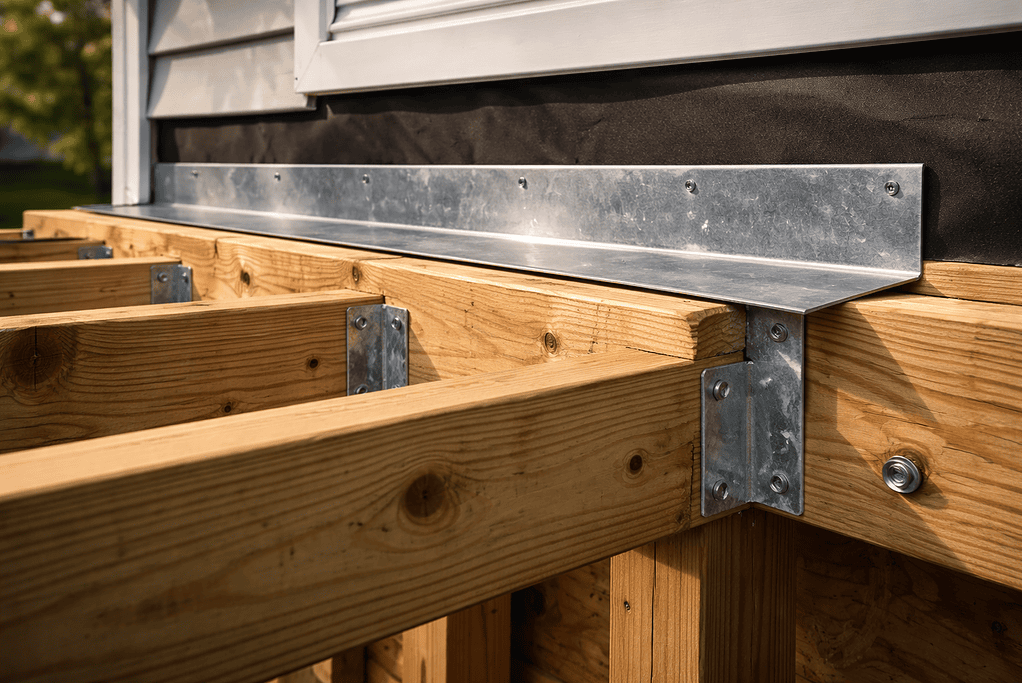
What Does Deck Flashing Look Like?
Many homeowners search for what does deck flashing look like, because most of the flashing system is hidden once the deck is finished. However, understanding its appearance helps illustrate how the system protects the structure.
The most recognizable component of deck flashing is Z-shaped metal flashing, commonly called a drip cap. This rigid piece of flashing is installed on top of the ledger board. One side slides behind the siding, while the lower edge extends outward over the ledger. Its angled shape creates a drip edge that forces water to flow away from the wall instead of behind it.
Behind the ledger board, builders typically install a self-adhering flashing membrane. This flexible waterproof layer sticks directly to the wall sheathing and seals around the bolts that secure the ledger board. Because water can travel along fasteners into the wall cavity, this membrane provides an important secondary barrier.
Some installations also include bottom flashing beneath the ledger board. This flashing detail helps prevent water that runs down the ledger from reaching the wall below. While not always required by building codes, many professional builders consider it a smart additional safeguard.
Modern decks often include joist flashing tape as well. This self-adhesive tape is installed on top of deck joists before decking boards are installed. It seals screw penetrations and prevents water from soaking into the framing, which can significantly extend the lifespan of the deck’s structural components.
Finally, the water-resistive barrier (WRB) behind the siding must overlap the flashing layers. This detail follows the “shingle principle,” meaning every layer above overlaps the layer below. This ensures water always drains outward instead of becoming trapped inside the wall assembly.
When all of these layers work together, the flashing system effectively redirects water away from the structure.
Is Flashing Required on a Deck?
Yes—flashing is typically required when a deck is attached directly to a house.
The International Residential Code (IRC) addresses this requirement in section R507.2.4, which states that corrosion-resistant flashing must be installed where a deck ledger connects to a dwelling. The purpose of this rule is to prevent water from entering the wall structure at the deck attachment point.
Flashing requirements generally apply in the following situations:
- Ledger-attached decks: Flashing is required to protect the connection between the deck ledger and the house structure.
- Freestanding decks: Flashing is usually not required because the deck does not connect directly to the house.
- Best-practice construction: Even when flashing is not strictly required, experienced builders still install moisture protection to extend the lifespan of the structure.
The reason codes emphasize flashing is simple: the ledger connection has historically been one of the most common points of deck failure.
Proper Deck Flashing Detail (Correct Installation Order)
A correct deck flashing detail follows one fundamental rule: water must always shed outward and downward.
If flashing layers are installed in the wrong order, water can become trapped behind the ledger board and accelerate structural decay. Proper installation ensures each layer directs water safely away from the structure.
A typical professional installation sequence includes the following steps:
- Remove or cut back siding. Builders first expose the wall sheathing behind the area where the ledger will attach. The ledger should never be installed directly over siding.
- Install a back flashing membrane. A self-adhesive waterproof membrane is applied to the sheathing to protect the wall and seal fastener penetrations.
- Install the ledger board. The ledger board is secured to the rim joist using structural lag screws or through-bolts that meet building code requirements.
- Install top Z-flashing. A rigid metal flashing piece is placed on top of the ledger board and tucked behind the siding.
- Lap the WRB over the flashing. The house wrap or building paper overlaps the flashing so water drains onto it rather than behind it.
- Reinstall siding. Siding is replaced while maintaining a small clearance above the flashing.
- Seal exposed penetrations. Sealant may be applied at specific points to prevent water intrusion.
When installed correctly, this layered system acts like a waterproof shield that directs water away from the deck structure.
What Type of Flashing for Deck Ledger?
Several materials can be used for deck ledger flashing. The best choice depends on durability requirements, climate conditions, and compatibility with pressure-treated lumber.
Common flashing materials include:
- Aluminum flashing: Lightweight, affordable, and easy to bend. However, aluminum should not come into direct contact with pressure-treated lumber unless a barrier membrane is installed, because chemicals in treated wood can cause corrosion.
- Galvanized steel flashing: Strong and widely available. It performs well in many environments but may corrode faster in coastal areas exposed to salt air.
- Stainless steel flashing: Highly durable and resistant to corrosion. It can safely contact treated lumber and is often used in high-moisture environments.
- Copper flashing: Extremely long-lasting and easy to shape. Copper is often used in premium construction but is typically the most expensive option.
- Vinyl flashing: Inexpensive and compatible with treated lumber. However, vinyl can become brittle in cold climates.
- Butyl flashing membranes: Self-adhesive waterproof membranes that seal around fasteners and provide excellent secondary protection behind ledger boards.
Choosing the correct material ensures that the flashing system remains durable and corrosion-resistant for decades.
Most Common Deck Flashing Mistakes
Even when flashing is installed, mistakes during construction can compromise its effectiveness. Many deck failures occur because flashing details were installed incorrectly.
Some of the most common flashing mistakes include:
- Installing the ledger board over siding instead of structural framing
- Skipping the self-adhesive membrane behind the ledger
- Installing flashing without a drip edge or slope
- Using caulk as the primary water barrier instead of flashing
- Allowing aluminum flashing to contact ACQ pressure-treated lumber
- Leaving no clearance gap between the house and the first deck board
These errors may not cause immediate problems, but they can allow moisture to infiltrate the structure over time.

Why Flashing Prevents Deck Collapse
Deck flashing plays a critical role in preventing structural failures. Without proper flashing, water can slowly damage the connection between the deck and the house.
When moisture reaches structural components, several problems can occur:
- Ledger boards can rot, weakening the primary support for deck joists.
- Structural fasteners can corrode, reducing their load-bearing capacity.
- Rim joists inside the house framing can deteriorate, weakening the entire connection.
- Structural separation can occur, eventually leading to deck collapse.
Because these problems develop gradually, homeowners often do not notice the damage until it becomes severe.
This is why building codes require flashing and why professional builders prioritize proper moisture protection during deck construction.
Indiana Climate Considerations
Deck flashing becomes even more important in climates like Indiana and the Midwest, where seasonal weather patterns create additional moisture challenges.
The region experiences several conditions that increase the risk of water damage:
- Freeze–thaw cycles can expand trapped moisture and cause wood fibers to split.
- High humidity levels increase the likelihood of wood rot and mold growth.
- Wind-driven rain can push water behind siding and toward the ledger connection.
- Snow accumulation and melting can concentrate moisture along the deck-to-house joint.
Because of these conditions, many experienced builders in the region install additional waterproof membranes and joist flashing tape to protect the deck structure.
Conclusion
Deck flashing may not be the most visible part of a deck, but it is one of the most important. By creating a layered moisture barrier at the deck-to-house connection, flashing protects the ledger board, rim joist, and wall structure from water damage.
A properly installed flashing system prevents rot, preserves structural integrity, and extends the lifespan of the deck.
If you are planning a new deck or evaluating an existing structure, understanding what deck flashing is and how it works can help ensure your deck remains safe, durable, and weather-resistant for many years.

Proven business leader with a strong track record of founding, growing, and scaling successful small businesses. Experienced in building companies from the ground up, driving sustainable growth, and leading teams through all stages of development. In the past year, led the delivery of 45+ custom deck projects. Skilled in identifying new business opportunities, developing and mentoring talent, and managing the full scope of daily operations—from sales and pricing strategy to financial oversight and execution. Known for operational excellence, strong financial acumen, and a continuous-improvement mindset that drives performance across every area of the business.