
Building a deck in Indiana may seem straightforward, but the reality is that deck railings are often more complex than homeowners realize. While a railing might look simple, inspectors view it as a critical safety feature — and railing mistakes are the leading cause of failed deck inspections and avoidable injuries.
The Indiana code for deck railing isn’t just a set of guidelines — it’s a mandatory safety standard. If you’re planning to install or repair a deck railing, this guide will break down the key requirements of Indiana’s building codes, common mistakes to avoid, and when DIY becomes dangerous. In most cities, railing compliance is reviewed as part of the overall deck permitting and inspection process, which is why understanding deck permit requirements in Indiana matters before you build or modify anything.
What This Guide Covers:
- A clear explanation of the Indiana code for deck railing, including height, spacing, and strength requirements.
- Common errors that often fail inspections and lead to costly rework.
- When you should hire a professional instead of attempting DIY deck railing installation.
What the Indiana Code for Deck Railing Actually Says
Understanding the specific regulations in the Indiana Residential Code (IRC) is crucial for any deck project. The following sections outline the most important aspects of Indiana’s code for deck railing, as prescribed by IRC R312 and local amendments.
Guardrail Height Requirements
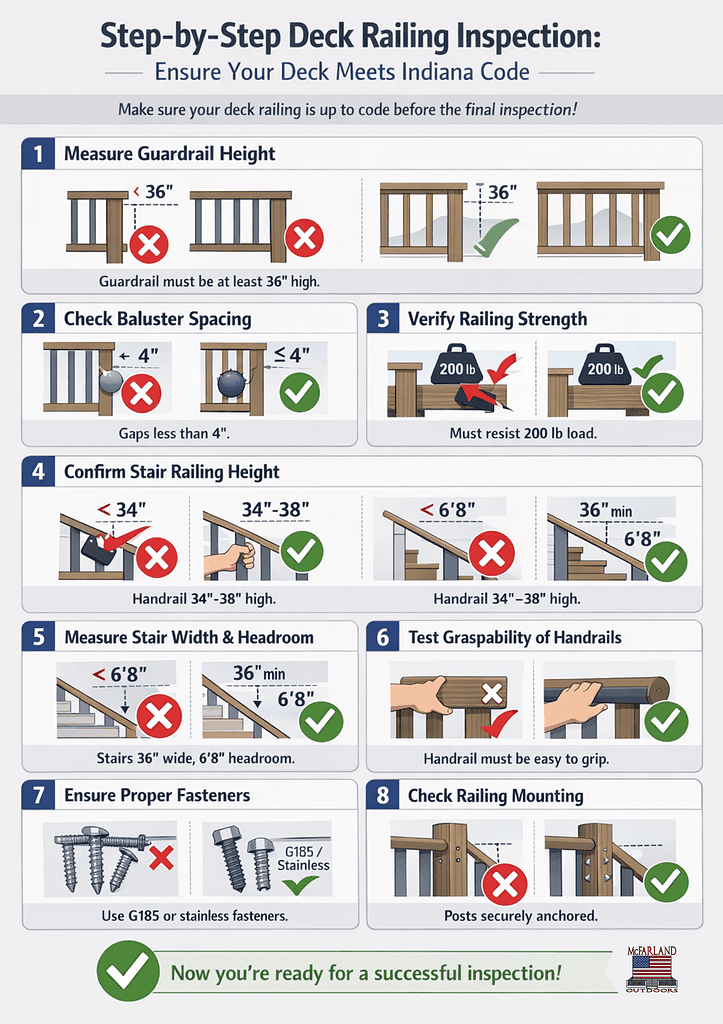
- Minimum Height: Deck guardrails must be at least 36 inches tall for any walking surface that is 30 inches or more above grade.
- Commercial vs. Residential: While commercial decks require a 42-inch height, residential decks in Indiana follow the 36-inch minimum.
- Height Measurement: The height is measured from the deck surface to the top of the guardrail.
Baluster Spacing & Opening Limits
- Sphere Test: The gaps between balusters must be small enough that a 4-inch sphere cannot pass through.
- Staircase Requirements: For stairs, the opening between balusters must be restricted further, following the stair “triangle” rule, which limits openings to under 6 inches.
Railing Strength Requirements
- Concentrated Load: The entire railing system must be able to resist a 200 lb concentrated load applied in any direction.
- Infill Strength: The infill (balusters or panels) must resist a 50 lb/ft horizontal load.
- Common DIY Failure: This is one area where many DIY projects fail, as many homeowners don’t realize the structural load demands of a deck railing.
Stair Railing Requirements
- Handrail Height: The handrail should be positioned between 34 and 38 inches above the stair tread nosing.
- Graspability: Handrails must allow a comfortable grasp (IRC Type I or II). This means the diameter or shape of the rail must enable you to fully grip it.
- 1.5″ Clearance: There should be at least 1.5 inches of clearance behind the handrail to allow for an effective grip.
Headroom & Width Requirements (Often Overlooked)
- Headroom: There must be a minimum of 6 feet, 8 inches of headroom on stairways.
- Stair Width: The stairway must have a clear width of at least 36 inches from handrail to handrail, measured above the handrail height.
The Most Common Indiana Railing Mistakes That Fail Inspection (or Fail in Real Life)
Here are the most common mistakes homeowners make that can lead to failed inspections — or worse, injuries. Many of these mistakes are flagged immediately during inspections. Reviewing a professional deck inspection checklist ahead of time helps homeowners understand what inspectors actually look for — not just what “looks right.”
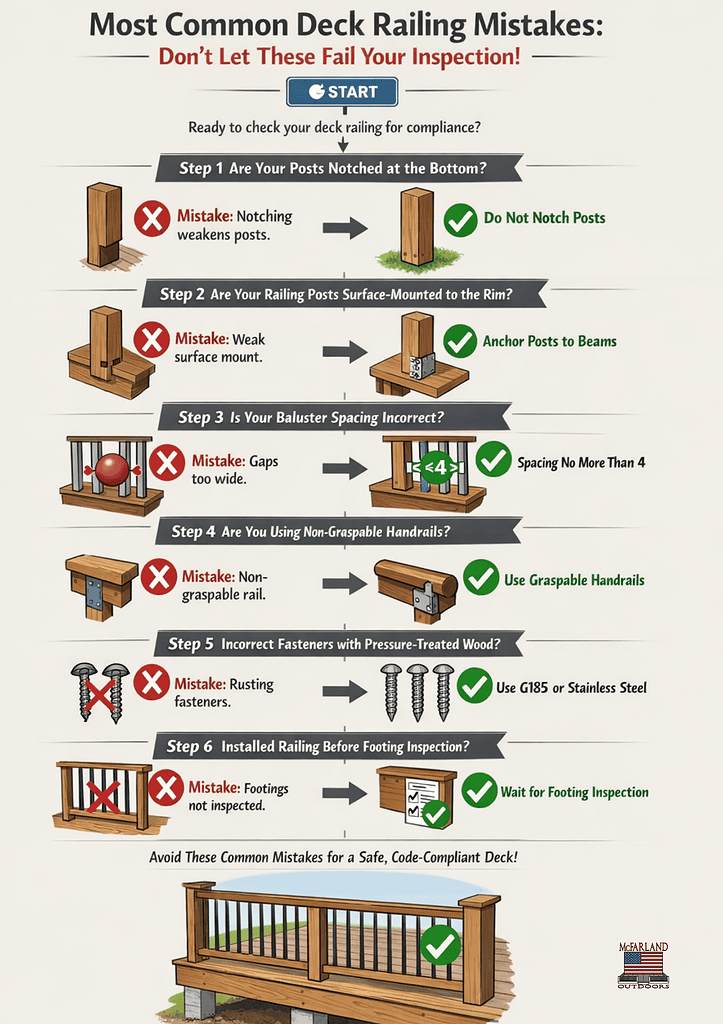
Railing Posts Surface-Mounted to the Rim (Weakest Possible Method)
- Why It Fails: Fasteners often pull out under load, and rim joists aren’t designed to transfer load without additional blocking and hold-downs.
- Code Violation: This method fails the 200 lb concentrated load test almost every time.
Posts Notched at the Bottom (Fatally Weak)
- Why It Fails: Notching removes the strongest fibers in the post, making it structurally compromised. Many DIYers unknowingly use these posts, even though inspectors reject them outright.
Balusters Spaced Wrong Because Homeowners Measure Center-to-Center Incorrectly
- Why It Fails: The 4-inch sphere rule applies to the gaps between balusters, not center-to-center. Improper measurements often result in dangerously large openings.
Stair Railings Attached to the Wrong Surface
- Why It Fails: Deck boards, fascia, or decorative trim aren’t structural framing and cannot hold the required load. Using screws alone will not meet the strength requirements.
Using Non-Graspable Rails (2x4s and 2x6s Are NOT Legal Handrails)
- Why It Fails: A legal handrail must allow you to fully wrap your fingers around it. The use of standard 2x4s or 2x6s is one of the most frequent code violations.
Mixing the Wrong Fasteners With Treated Lumber
- Why It Fails: Electro-galvanized or black-oxide fasteners corrode quickly when used with pressure-treated wood. G-185 or stainless steel is required for longevity.
Railing Installed Before the Footings Are Inspected
- Why It Fails: Installing the railing before the footings are inspected means the inspector cannot verify the posts and blocking, leading to a requirement for tear-back.
When Indiana Homeowners Should NOT DIY Deck Railings
While DIY projects can be rewarding, there are certain situations where installing a deck railing without professional help is dangerous and not recommended.
If the Deck Is More Than 30″ Above Grade
- Why Not DIY: One mistake here can lead to a fall hazard, and the railing is a life safety feature, not just a cosmetic addition.
If the Railing Connects to a Cantilevered Section
- Why Not DIY: Rim boards aren’t built to resist lateral loads. Specialized blocking and hold-downs are required by the code.
If You’re Rebuilding an Old or Rotted Deck Frame
- Why Not DIY: The structural integrity of the deck frame is critical. If the framing is compromised, even a well-built railing will fail to meet safety standards.
If You Bought a Pre-Packaged Railing Kit
- Why Not DIY: Most pre-packaged kits don’t meet Indiana’s required load capacity unless upgraded hardware is used, and most instructions fail to mention IRC R312 compliance.
If You Have Stairs
- Why Not DIY: Stair railings are one of the most common code violations. Stair geometry, handrail continuity, and landing size require professional expertise.
If You Want to Pass Inspection the First Time
- Why Not DIY: Inspectors rarely offer second chances, and railing mistakes almost always lead to re-inspection fees.
How a Professional Ensures Your Railing Actually Meets Indiana Code
Hiring a professional isn’t just about convenience — it’s about safety and compliance. Here’s how a deck railing pro ensures that your project meets every code requirement.
We Build the Load Path, Not Just the Rail
- Proper blocking, hold-downs, and through-bolts create a load path that ensures your railing is safe and durable.
We Use G185 or Stainless Hardware Everywhere
- Corrosion resistance is critical in Indiana’s freeze-thaw climate, and we use only high-quality, durable fasteners.
We Engineer Stair Railings to the Exact Geometry
- No more guessing: we ensure that risers are zero-tolerance, nosings are legal, and handrails meet graspability requirements.
We Anchor Rail Posts to Beams or Properly Reinforced Joists
- We never attach rail posts directly to the rim board — only to beams or reinforced joists.
We Know Local Amendments
- Indiana’s local amendments can vary by county. We ensure that your deck meets all the necessary requirements, whether you’re in Indianapolis, Hamilton County, or beyond.
Code-Right Railing Options for Central Indiana Homes
Choosing the right railing material can be just as important as following the code. Here are some options that meet Indiana’s requirements:
- Wood Railing: Classic, but ensure it’s pressure-treated and properly reinforced.
- Aluminum Railing: Lightweight, durable, and low-maintenance.
- Composite Railing: A great choice for longevity and aesthetic appeal.
- Cable Railing: Requires tension testing and special posts to meet load-bearing requirements.
- Glass Railing: Thicker tempered glass panels are necessary to comply with the code.
Conclusion
Indiana’s deck railing codes are strict because they’re designed to protect lives, not just pass inspections. If your deck needs a new railing, reinforcement, or a full rebuild to meet code, working with an experienced deck contractor ensures it’s done safely the first time.
Ready to make sure your deck railing complies with Indiana code? Contact us to get started on a safe, strong, and compliant deck today.

Proven business leader with a strong track record of founding, growing, and scaling successful small businesses. Experienced in building companies from the ground up, driving sustainable growth, and leading teams through all stages of development. In the past year, led the delivery of 45+ custom deck projects. Skilled in identifying new business opportunities, developing and mentoring talent, and managing the full scope of daily operations—from sales and pricing strategy to financial oversight and execution. Known for operational excellence, strong financial acumen, and a continuous-improvement mindset that drives performance across every area of the business.