
Indiana deck building codes are not bureaucratic red tape — they are safety and liability safeguards. These rules exist for a reason: they prevent structural failures, unstable stairs, and dangerous railing gaps that can lead to severe injuries. In fact, every year more than 6,000 people suffer serious injuries, lifelong disabilities, or even death due to balcony or deck collapses and structural failures. Non-compliant decks significantly increase these risks and can also trigger failed inspections, fines, forced modifications, insurance claim issues, and serious resale problems when permits or code compliance are questioned.
In Indiana, and particularly in Indianapolis, deck requirements are shaped by the Indiana Residential Code plus local amendments, zoning setbacks, and inspection protocols.
As an Indianapolis-based deck builder experienced with local permitting and inspections, we’ve seen where homeowners run into trouble.
This guide explains the permits, structural rules, railings, stairs, loads, and common violations you must understand before building.
What Are Deck Building Codes?
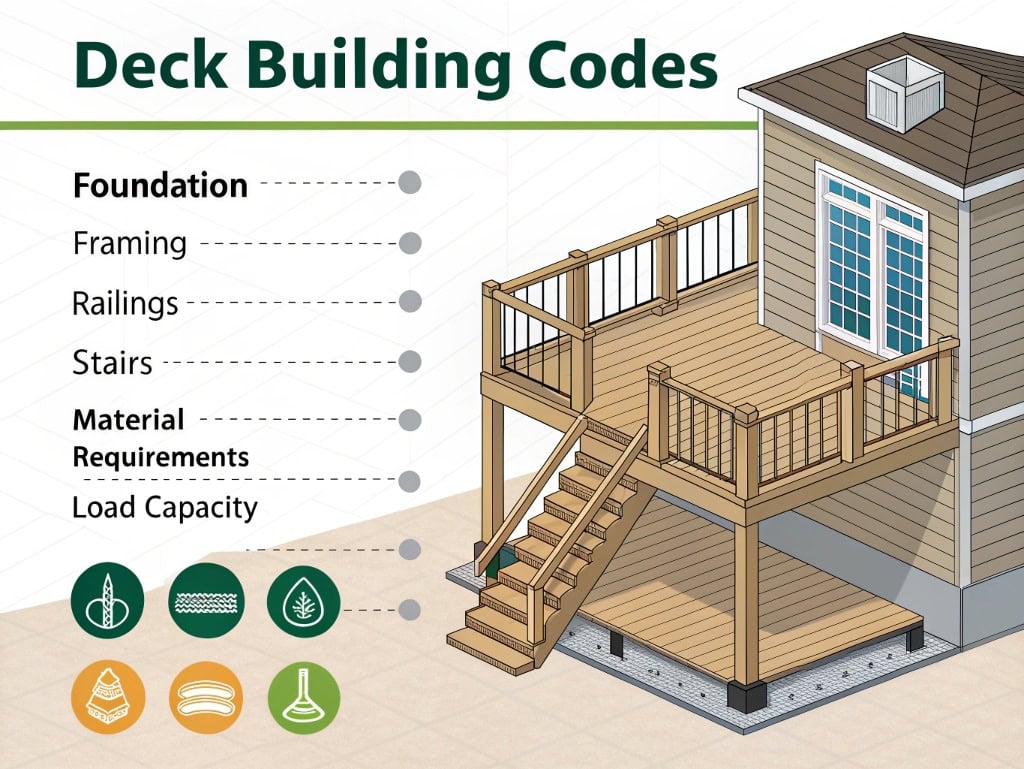
Deck building codes are legally adopted construction standards that regulate structural safety, fall protection, durability, and load capacity. They exist to reduce structural failure risk, prevent fall hazards, and ensure long-term durability under real-world loads and weather exposure.
Rather than prescribing aesthetics, these rules regulate performance and safety. They define how loads are transferred through footings, posts, beams, and joists; how connections must resist gravity and lateral forces; and how features like guardrails and stairs protect occupants. Codes also address durability concerns such as frost protection, decay resistance, corrosion-resistant hardware, and moisture management.
In practical terms, deck codes control:
- Structural capacity (loads, spans, deflection limits)
- Connection integrity (fasteners, hardware, ledger attachment)
- Fall protection (guardrails, handrails, stair geometry)
- Foundations (footing depth, sizing, soil bearing)
- Material standards (treated lumber, exterior-rated connectors)
These requirements are designed around predictable failure points. Deck collapses most often occur at ledgers, connections, and inadequately supported framing — exactly where codes impose the strictest rules.
In short, Indiana deck building codes define the minimum acceptable safety and structural standards, not best-case craftsmanship or design upgrades.
Which Building Code Does Indiana Use?
Residential deck construction in Indiana is governed by the Indiana Residential Code (IRC). This is Indiana’s state-level adoption of the International Residential Code (IRC), modified with state-specific amendments, deletions, and clarifications.
By using the IRC framework, Indiana aligns with nationally recognized structural engineering principles, span tables, and safety provisions as defined by the International Residential Code (IRC). However, the state does not automatically adopt every new IRC edition. Only formally adopted versions become enforceable, which means applicable requirements depend on Indiana’s current adoption cycle.
The Indiana Residential Code establishes standards for:
- Structural framing systems
- Deck connections and fasteners
- Footings and foundations
- Guards, handrails, and stairs
- Design loads (live, dead, snow)
Local jurisdictions, including Indianapolis, are responsible for enforcement. Municipal building departments handle permits, inspections, zoning compliance, and may apply local amendments or interpretations. While the baseline rules originate at the state level, administration and compliance verification occur locally.
This layered structure explains why two decks built similarly may receive different correction notices across jurisdictions. Compliance requires aligning with both Indiana state code and local municipal regulations.
Indianapolis Deck Permit Requirements
Deck permits in Indianapolis are administered by the Dept. of Business & Neighborhood Services (BNS), the city agency responsible for enforcing zoning and residential construction regulations. In practice, homeowners should assume that nearly all new decks, full replacements, and significant structural modifications require approval before construction begins. The permit review process ensures the project complies with local setback rules, property line restrictions, and the structural provisions of the Indiana Residential Code and applicable Indiana deck building codes.
Typical Documents Required
A smooth permit approval depends on clear, detailed documentation. The site plan establishes where the deck will be built in relation to the property. It typically identifies lot boundaries, dimensions, the existing home, and the proposed deck location, along with distances from lot lines, easements, and nearby structures such as garages or sheds. Without this information, zoning compliance cannot be verified.
The structural details describe how the deck will be constructed. These drawings outline the framing plan — including posts, beams, and joists — as well as lumber sizes, spacing, connection methods, and specifications for guardrails and stairs. Reviewers use these plans to confirm that loads are transferred safely and that fall protection elements meet code.
A footing layout completes the submission. This document specifies footing locations, diameters, depths below grade for frost protection, and pier or sonotube dimensions where applicable. Incomplete or vague drawings are one of the most common causes of permit delays and correction requests.
Estimated Approval Timelines
Approval timelines vary depending on workload and submission quality. Complete residential deck applications are often reviewed within 5 to 15 business days. When revisions are required, however, the process can extend by days or weeks — particularly during peak building season in spring and summer. Online submissions typically move faster than paper-based corrections.
Inspection Process Overview
Most decks require multiple inspections aligned with key construction stages. The footing inspection takes place before concrete is poured to verify depth and bearing conditions. The framing inspection occurs before decking conceals structural members and connectors. The final inspection confirms compliance of railings, stairs, hardware, and overall structural integrity.
Work cannot legally proceed beyond certain phases without passing inspections. Skipping required approvals often results in stop-work orders or costly corrective work.
Pro Tip: In Indianapolis, the most frequent inspection failures involve insufficient footing depth, improper ledger fastening, and guardrail spacing violations.
Indiana Deck Footing Requirements
Footings serve as the primary structural anchor of any deck, transferring loads safely into the ground. When this foundation is compromised — whether by insufficient depth, undersizing, or poor soil support — the problems tend to compound. Settlement, post movement, ledger stress, and long-term structural instability often trace back to footing errors.
Minimum Depth (Frost Line Protection)
In Indiana, deck footings must extend below the local frost depth to prevent movement caused by freeze–thaw cycles. In the Indianapolis area, this typically means a minimum depth of approximately 36 inches below grade in much of central Indiana, though local soil conditions and municipal enforcement may require deeper placement. Footings that are too shallow are one of the most common code violations and a frequent cause of decks that shift, tilt, or develop uneven framing stresses over time.
Footing Diameter / Size
Footing size is determined by structural load and soil bearing capacity — not visual judgment. Variables such as deck size, tributary load distribution, post spacing, and anticipated snow or live loads all influence required dimensions.
For example, a 12×16 deck supporting a 40 psf live load may require 12–16″ diameter footings depending on soil bearing capacity (typically assumed at 1,500 psf unless verified).
Undersized footings often perform adequately at first, yet settlement and movement tend to emerge as loads accumulate and soil conditions change.
Soil Considerations
Soil stability plays a critical role in footing performance. Loose or recently disturbed soil, high clay content prone to expansion and contraction, poor drainage, standing water, or fill placed near foundations can significantly reduce bearing capacity. In these conditions, inspectors may require deeper or wider footings to achieve adequate load distribution. Ignoring soil characteristics is a frequent contributor to structural movement and inspection failures. Clay-heavy soils common in Indiana can expand and contract significantly with moisture changes, influencing long-term deck movement.
Concrete vs Alternative Systems
Concrete footings remain the most common solution because they provide predictable load capacity and long-term durability for permanent decks. Alternatives such as helical/screw piles or precast deck blocks may be approved in specific scenarios, but only when they meet structural load ratings, frost protection requirements, and manufacturer installation standards. Many lower-cost alternatives fail inspection not because they are inherently flawed, but because they are applied outside their intended design limits.
The practical takeaway is straightforward: footing depth, diameter, and soil preparation largely determine whether a deck remains stable for decades or begins showing movement within a few seasons.
Deck Post & Beam Code Requirements
Posts and beams create the primary load path of a deck, transferring weight from the framing down into the footings. When these components are undersized or improperly connected, the symptoms are predictable: sagging beams, noticeable sway, and in severe cases, structural failure.
Post Sizing
Deck posts must be capable of supporting vertical loads from beams and joists while also resisting lateral forces. For many residential applications, 4×4 posts may be permitted on low-height decks with modest spans. However, 6×6 posts are commonly preferred — and often required — for taller decks, longer beam spans, or heavier design loads. Post sizing is influenced by deck height, tributary load distribution, beam configuration, and wind or lateral forces. In inspections, undersized posts are a frequent issue because the structural risk may not be visually obvious until movement develops.
Beam Span Requirements
Beam sizing isn’t arbitrary. Allowable spans are dictated by lumber species, grade, built-up configuration, post spacing, and design loads. Codes rely on span tables rather than rules of thumb. A beam that exceeds its allowable span may look stable at first yet gradually develop deflection, which can affect decking, railings, and connection points. Allowable spans are determined using code-approved span tables based on lumber species, grade, and loading assumptions — not contractor rules of thumb or visual judgment.
Approved Connectors & Hardware
Structural connections must use code-approved metal connectors designed for load transfer. This typically includes post bases that elevate wood above concrete, beam-to-post connectors, joist hangers, and through-bolts or structural screws. Nails alone are rarely sufficient for critical structural joints. Hardware must be corrosion-resistant, rated for exterior use, and installed with the correct fasteners. Improper connector installation is a common cause of inspection corrections.
Because modern pressure-treated lumber contains copper-based preservatives, connectors and fasteners must be specifically rated for corrosion resistance.
Lateral Stability Rules
Decks must resist side-to-side movement and pull-away forces, particularly on taller structures, freestanding decks, or decks supporting stairs and concentrated loads. Achieving stability often requires diagonal bracing, lateral load connectors at the ledger, and proper post anchorage. Lateral failures are a known contributor to deck collapses, which is why inspectors evaluate these details carefully.
Deck Joist Requirements
Joists support the decking surface and channel loads into the beams. Errors in spacing or span design often result in bouncy deck surfaces, visible sagging, and long-term structural stress.
Joist Spacing
Joist spacing directly affects deck stiffness. 16 inches on-center (OC) is standard for most wood decking. Composite and PVC decking typically require tighter spacing — often 12 inches OC — to limit flexing. Spacing of 24 inches OC is permitted only in limited scenarios with appropriate decking thickness and strict span compliance. Manufacturer requirements frequently override default assumptions, especially with composite materials.
Span Limits
Allowable joist spans depend on joist dimensions (such as 2×8 or 2×10), lumber species and grade, live and dead load design, and deck usage. Building codes reference span tables rather than visual judgment. Joists that exceed allowable spans rarely collapse outright, but they commonly develop noticeable deflection and a ‘bouncy’ feel. Excessive deflection doesn’t just affect comfort — it accelerates fastener loosening, connection fatigue, and long-term structural wear. Building officials evaluate joist spans using IRC span tables, which account for lumber properties and design loads rather than generalized spacing assumptions.
Lumber Grade & Species Considerations
Not all lumber performs equally. Higher-grade material permits longer spans, while different species — for example, Southern Pine versus SPF — have different load capacities. Because decks are exposed to weather, pressure-treated lumber is typically required. Using the wrong species or grade can invalidate span calculations.
Cantilever Rules
Joists may extend past beams within defined limits, commonly restricted to no more than one-quarter of the back span, depending on code. Excessive cantilevers increase bounce and place additional stress on connections.
Ledger Board Attachment Codes
The ledger board is one of the most failure-prone elements in deck construction because it transfers deck loads directly into the home’s structure. This risk profile is consistent with failure data and safety guidance published by the North American Deck & Railing Association (NADRA).
Why This Is Critical for Safety
A compromised ledger connection can allow the deck to separate from the house, potentially resulting in sudden structural failure and serious injury. Common problems include inadequate fasteners, missing flashing, and attachment to non-structural surfaces.
Field investigations consistently show that ledger connection failures are the single most common cause of deck collapses.
Fastener & Spacing Requirements
Ledger fastening must follow code-prescribed schedules. This typically requires through-bolts or structural screws of specified minimum diameter — often ½ inch, subject to local verification — installed in defined horizontal and vertical spacing patterns with proper edge distances. Nails-only attachment, drywall screws, or random fastener placement are not acceptable. Fastener spacing varies based on joist span, deck load, and fastener type. Guard and ledger connections are also designed to resist concentrated loads (often 200 lbs per code requirements), reflecting real-world occupant forces.
Flashing Requirements
Flashing protects the ledger connection from water intrusion, which can cause rot, hidden decay, and eventual connection failure. Proper installations include continuous corrosion-resistant metal flashing integrated with the home’s weather barrier and detailed to direct water away. Missing or incorrectly installed flashing frequently results in inspection failures.
Prohibited Attachment Scenarios
Ledger boards generally cannot be attached to brick veneer, stone veneer, stucco without engineered detailing, cantilevered house sections, or rim boards not designed for load transfer. In these conditions, decks must be built as freestanding structures supported by independent posts and beams.
Indiana Deck Load Requirements
A deck’s structural design is based on expected loading conditions, not simply its own weight. Underestimating load demands is a common but often invisible risk, leading to excessive deflection, connection stress, and long-term structural fatigue.
Live Load Standards
Most residential decks are engineered around a design live load of approximately 40 pounds per square foot (psf), the prescriptive standard referenced by the International Residential Code (IRC). This allowance accounts for typical use, including occupants, outdoor furniture, grills, and other movable items. While this standard works for everyday conditions, higher occupancy levels or concentrated loads — such as large gatherings or heavy planters — may require structural upgrades to beams, joists, or footings.
Snow Load Considerations
Indiana’s seasonal snow and ice accumulation introduces additional structural demands. Required design loads vary by geographic location, roof-to-deck interaction, and the potential for drifting. In certain scenarios, snow loads can exceed standard live load assumptions, particularly on elevated decks or partially covered structures where drifting occurs. Ignoring snow load factors can contribute to sagging and framing stress over time.
Special Use Cases (Critical Design Impact)
Certain deck features dramatically alter load requirements. Hot tubs and spas impose extremely high concentrated loads and typically require engineering review, along with reinforced framing and expanded footing systems. Outdoor kitchens and fireplaces add heavy static loads that may demand point-load reinforcement. Structures such as pergolas or roof covers introduce both vertical and lateral forces, including wind uplift considerations. Without appropriate upgrades, these additions can result in deflection or structural failure.
A filled hot tub can impose concentrated loads exceeding 4,000 to 6,000 pounds — far beyond standard residential deck assumptions.
Electrical Code Considerations for Decks
Any electrical installation on or near a deck must comply with the National Electrical Code (NEC) as adopted in Indiana and enforced locally per NEC safety requirements for wet and damp locations. Exterior environments introduce moisture and exposure risks that demand specialized materials and protection.
Outlet (Receptacle) Requirements
For decks attached to a dwelling, codes typically require at least one exterior receptacle that is readily accessible from the deck surface. These outlets must be weather-resistant (WR rated) and protected with an approved in-use cover. Running extension cords through doors or windows is neither safe nor code-compliant and often creates both trip and shock hazards.
Lighting Rules
Code requirements and safety best practices emphasize adequate illumination at exterior doors accessing the deck, as well as clear visibility along stairs and landings. Fixtures must be rated for wet or damp locations. Insufficient lighting is a well-documented contributor to nighttime falls.
GFCI Protection
Most deck-related receptacles and circuits require GFCI protection (Ground Fault Circuit Interrupter). This protection applies to exterior outlets, circuits near wet or damp locations, and specialized installations such as hot tubs or spas. GFCI devices are designed to reduce shock hazards in moisture-prone environments.
Conduit & Wet Location Standards
Exterior wiring must be installed within approved conduit or cable assemblies rated for wet locations. Proper support and physical protection are essential. Exposed wiring or interior-rated materials will not pass inspection.
Common Code Violations (And How to Avoid Them)
Most deck inspection failures stem from predictable, preventable mistakes, not complex structural defects. Many of these violations mirror the most frequently cited correction items identified during municipal inspections.
Improper Ledger Attachment
Ledger failures often result from using nails instead of structural fasteners, incorrect bolt or screw spacing, missing flashing, or attachment to non-structural surfaces like brick veneer. Avoid these issues by using code-approved through-bolts or structural screws, following prescribed fastening schedules, installing continuous flashing, and building a freestanding deck when the attachment surface cannot safely transfer loads.
Shallow Footings
Footings placed above frost depth, undersized in diameter, or poured on loose soil frequently trigger inspection corrections. Proper installations extend below local frost depth — commonly around 36 inches in many Indiana areas — are sized based on structural load, and bear on undisturbed or properly compacted soil.
Railing Spacing Mistakes
Guardrail violations commonly involve openings that exceed the 4-inch sphere rule (openings must prevent passage of a 4″ diameter sphere), weakly anchored posts, or decorative infill that compromises safety. Compliance requires verifying spacing before final fastening, anchoring posts to structural framing rather than decking boards, and using rated connectors and blocking.
Stair Geometry Errors
Stair-related failures often involve inconsistent riser heights, shallow treads, or missing/graspability-deficient handrails. Uniform riser and tread dimensions, adherence to rise/run limits, and installation of graspable handrails where required are essential for both safety and inspection approval.
Can You Build Your Own Deck in Indiana?
Legal Allowances
Indiana generally permits homeowners to build their own deck on a primary residence, but that freedom comes with conditions. Proper permits must be obtained, the work must comply with the Indiana Residential Code and applicable local regulations, and all required inspections must be passed. While the state allows owner-built projects, some municipalities apply stricter scrutiny, particularly when documentation or structural details are incomplete.
Risks of DIY Deck Construction
A deck may look like a straightforward carpentry project, but structurally it functions as a load-bearing system. DIY builders commonly run into issues such as incorrect span calculations, improper ledger attachment, undersized footings, and non-compliant railing or stair geometry. The challenge is that many of these mistakes are not immediately visible. Problems often surface later as movement, sagging, or connection stress — sometimes after seasonal freeze–thaw cycles expose weaknesses.
Inspection Failures
From an inspection standpoint, owner-built decks fail more frequently than professionally constructed ones. The reasons are predictable: missing drawings, misinterpretation of code requirements, concealed structural errors, or the use of improper hardware and fasteners. Failed inspections lead to delays, mandatory corrections, and additional expenses that can quickly erode any perceived savings.
Warranty & Liability Concerns
DIY decks also lack the protections typically provided by licensed contractors. There is no workmanship warranty, no structural guarantee, and no contractor liability coverage. If a failure results in property damage or personal injury, the homeowner assumes full legal and financial responsibility — a risk many underestimate when deciding to build without professional involvement.
How Codes Affect Deck Design & Cost
Building codes play a decisive role in both how a deck is constructed and what it ultimately costs. Compliance is not optional, and it influences everything from material selection to structural design and labor requirements. While codes may appear to add constraints, they are fundamentally about safety, durability, and long-term performance.
Impact on Materials
Codes establish minimum standards for the materials used in deck construction. This typically means pressure-treated or naturally decay-resistant lumber, corrosion-resistant fasteners and connectors, and framing members sized according to span and load requirements. Guardrail systems and stair components must also meet specific safety criteria. In many cases, homeowners planning to use lower-cost or interior-grade materials discover that upgrades are necessary to satisfy structural and exposure standards. These adjustments are not cosmetic — they are essential for preventing premature deterioration and safety failures.
Structural Upgrades
Code compliance often drives structural decisions that affect cost. Longer spans may require larger beams or joists. Soil conditions and frost depth rules can necessitate deeper or wider footings. Elevated decks frequently need additional posts, bracing, or lateral load connectors to control movement. When features such as hot tubs, fireplaces, or roof structures are introduced, engineering-based reinforcements are typically required. These upgrades increase upfront expense but directly reduce the risk of deflection, instability, and future repairs.
Permit & Inspection Costs
Permits and inspections represent another cost component. Typical expenses may include application fees, plan review charges where applicable, and reinspection fees if corrections are required. Although skipping permits may seem like a way to save money, it often results in significantly higher costs later — particularly if unpermitted work must be modified, legalized, or removed during resale or after a failed inspection.
Long-Term Safety vs Upfront Savings
Attempts to reduce initial costs by cutting corners frequently lead to larger financial consequences. Structural movement, moisture intrusion, safety hazards, and expensive retrofits are common outcomes of non-compliant construction. By contrast, a code-compliant deck protects occupant safety, preserves home value, and reduces insurance and liability risks.
In practical terms, codes may increase the initial investment, but they dramatically improve the deck’s structural reliability and lifespan.
Work With a Code-Compliant Indianapolis Deck Builder
When it comes to decks, code compliance isn’t optional — it’s safety and long-term value. A poorly built deck may pass a quick glance but can still hide structural weaknesses, inspection failures, or safety risks that show up months or years later. Choosing a reputable builder means your deck is designed from the start with proper footings, framing, fasteners, flashing, railings, and stair systems that meet or exceed code expectations.
At McFarland Outdoors, we handle permits, plan preparation, and inspections so you don’t have to navigate municipal requirements on your own. Our process ensures that designs align with Indiana deck building codes and Indianapolis building regulations, and our crews coordinate with inspectors at footing, framing, and final stages to prevent costly setbacks.
We don’t just build decks — we deliver structurally sound outdoor living spaces, from wood and composite decks to integrated stairs and rail systems, with safety and durability at the forefront.
Ready to build with confidence? Contact us for a consultation and custom estimate — we’ll assess your site, clarify code requirements, and outline a plan that protects your investment and your family.
Conclusion
Indiana deck building codes ultimately exist to protect homeowners, occupants, and property value. What may seem like technical requirements — footing depth, ledger fastening, guardrail spacing, load design — directly determines whether a deck remains safe, stable, and insurable over time. Ignoring these standards often leads to inspection failures, structural problems, and expensive corrective work.
Whether you’re planning a new build or evaluating an existing structure, understanding the rules early prevents costly mistakes later. A code-compliant deck isn’t just about passing inspection — it’s about long-term safety and performance.
If you’re building in Indianapolis, working with an experienced professional ensures your design, permits, and construction align with both state and local requirements.

Proven business leader with a strong track record of founding, growing, and scaling successful small businesses. Experienced in building companies from the ground up, driving sustainable growth, and leading teams through all stages of development. In the past year, led the delivery of 45+ custom deck projects. Skilled in identifying new business opportunities, developing and mentoring talent, and managing the full scope of daily operations—from sales and pricing strategy to financial oversight and execution. Known for operational excellence, strong financial acumen, and a continuous-improvement mindset that drives performance across every area of the business.